
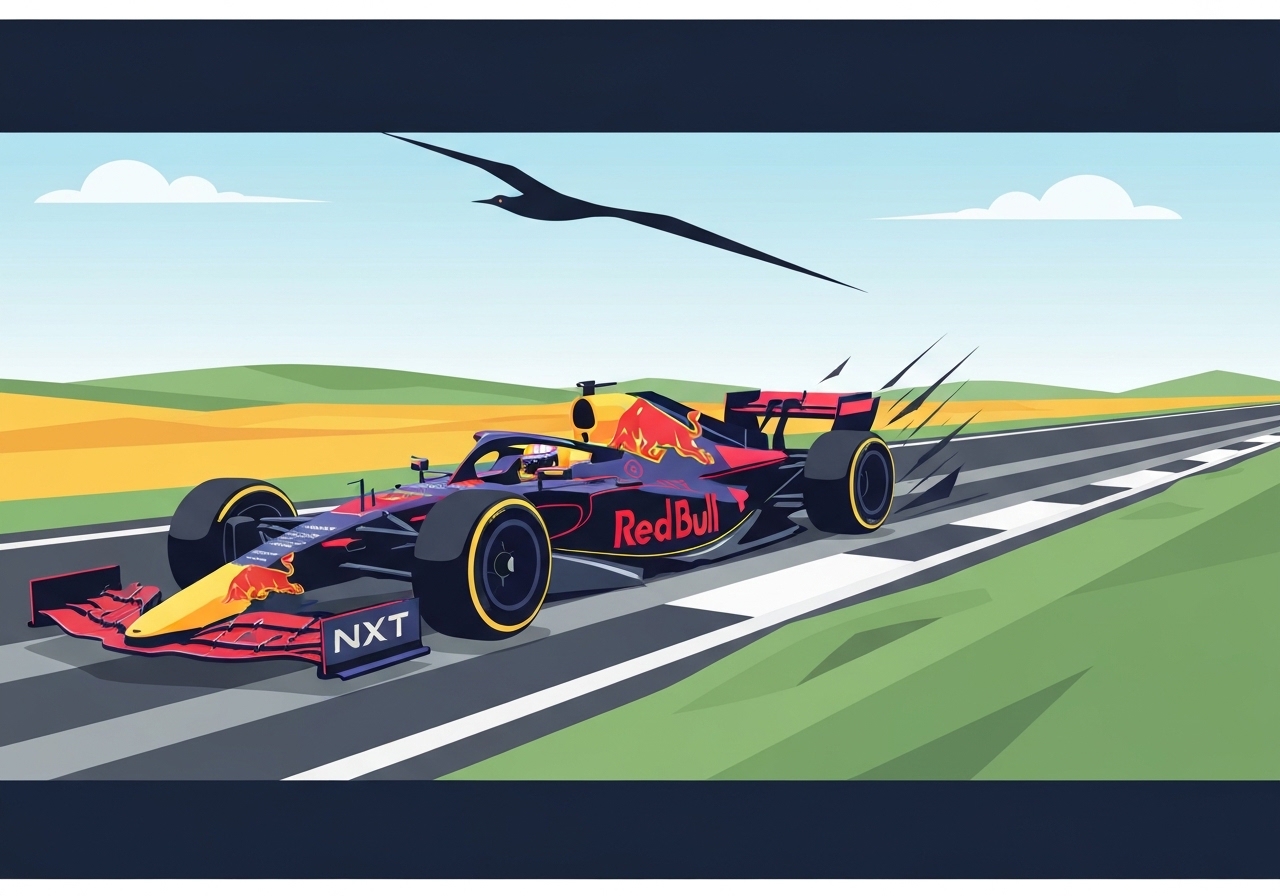
Lead: Red Bull presented its 2026 Formula 1 launch as a livery reveal but also showed a studio-rendered car that differs in multiple, noticeable ways from the official F1 showcar displayed at the event. The physical showcar at the launch was the 2026 FIA/Formula 1 model produced by Memento, while Red Bull’s released studio imagery appears to be the team’s own visualisation of the new regulations rather than a confirmed RB22 prototype. Key changes visible in the studio images include revised wing details, tighter sidepod packaging and a repositioned cockpit. The true RB22 will only be verifiable on the first day of the opening pre-season test in Barcelona later this month.
- Red Bull framed the event as a “livery launch” while circulating studio images that diverge from the official F1 showcar produced by Memento.
- Studio renders show altered front and rear wing details and new-style front wing endplates not present on the Memento-built showcar.
- Sidepods in the studio visuals are more tightly packaged, exposing more floor and adding detail in the rear corners—suggesting different aerodynamic priorities.
- The front-of-floor fence is presented as a three-element structure, an evolution from the single-block fence used in the FIA/Formula 1 showcar.
- The studio car depicts a cockpit set further rearward and a pushrod front suspension, versus the pullrod arrangement on the official showcar.
- Memento is confirmed as the builder of the F1 showcar used at the event; teams can commission bespoke studio models from Memento.
Background
Formula 1’s 2026 technical regulations reset many aerodynamic and packaging conventions, prompting teams to use showcars and studio renders to demonstrate livery and conceptual interpretations of the new rules. For launch events, teams typically balance spectacle and secrecy: a publicly shown ‘showcar’ can be a marketing piece rather than a final development mule. Memento, the model and display specialist, produced the physical 2026 showcar used at the launch; that same showcar has been used by Formula 1 for event promotion. At the same time, teams frequently commission their own studio visualisations to explore packaging and styling within the new rule constraints—these do not necessarily represent finished race hardware.
In recent seasons, the gap between concept imagery and running prototypes has widened as CFD and wind-tunnel development accelerate in private. The 2022 regulations had already removed complex bargeboards and reshaped the balance of downforce generation, which changed how teams design sidepods and floor edges. With 2026’s fresh constraints, visual interpretations can show aggressive packaging choices—tight sidepods, exposed floors and intricate fences—without those details being locked into the first race-worthy chassis. Stakeholders—engineers, commercial teams and sponsors—use both physical showcars and studio visuals to communicate different messages: the former as a safe public artifact, the latter as an aspirational engineering direction.
Main Event
At the launch, Red Bull displayed the Memento-built 2026 showcar used across Formula 1’s promotional material; that car matched the standard F1 showcar profile seen at other team events. The Memento showcar emphasizes a clean, broadly rule-compliant silhouette and serves primarily to carry livery and sponsor activation for photoshoots and fan events. Separately, Red Bull issued studio images that, on close inspection, introduce numerous technical distinctions—particularly around wing geometry and sidepod shaping—which were not present on the physical showcar. The team marketed the occasion as focused on livery, but the simultaneous release of detailed studio renders blurred the line between brand presentation and technical signaling.
Visual differences are not trivial. The studio renderings include reworked front-wing endplates and front brake duct treatments that suggest a different aerodynamic approach than the showcar. Around the floor, the studio version’s forward fence is split into three elements rather than the single block visible on the F1 showcar, resembling a simplified return of pre-2022 bargeboard complexity in miniature. The sidepods in the studio images are sculpted to be much tighter, revealing more of the underfloor—an approach consistent with maximizing diffuser and floor performance under the new rules. At the rear, the studio concept adds detail around the rear corner and the exit areas, hinting at refined flow control that the showcar does not display.
Perhaps the most notable changes in the studio artwork are packaging decisions: the cockpit is drawn further back, which is generally beneficial for aerodynamic balance and weight distribution, and the front suspension is shown as pushrod instead of pullrod. Switching suspension layout in a studio render is a surprising detail to alter unless it reflects an engineering choice under consideration for the RB22. However, without a shakedown or on-track appearance, there is no direct confirmation that those geometry choices will appear on the first race chassis. The definitive comparison will come at the Barcelona pre-season test, when teams run actual hardware for the first time.
Analysis & Implications
Studio renders serve multiple purposes: they can be marketing assets, internal development visuals, or deliberate signals to rivals and sponsors. In Red Bull’s case, the studio car appears to communicate an engineering direction—tighter packaging and targeted floor detailing—while protecting specifics by not presenting a running mule. That approach preserves competitive confidentiality: rivals see plausible concepts but cannot validate structural or aero details without telemetry or track footage. For sponsors and fans, the studio imagery enhances the impression of technical progression under the new rules, even if some features remain aspirational.
Technically, the depicted rearward cockpit and exposed floor area suggest Red Bull (or its design team) is prioritizing airflow quality into the diffuser and along the floor, which fits aerodynamic strategies under the 2026 rule set. A pushrod front suspension, if implemented, would change the load path into the chassis and alter aerodynamic packaging at the nose and top of the chassis—details that can have measurable lap-time effects. If those choices reflect genuine engineering direction, they could indicate Red Bull exploring a different compromise between suspension geometry and aero cleanliness compared with the showcar baseline.
Strategically, issuing a more technical studio image while labeling the launch a livery reveal protects Red Bull from criticism about prematurely exposing development lines while still shaping narrative control. It also allows the team to test public reaction to particular styling and technical cues without committing resources to a broadly publicized prototype. Internationally, rival teams will catalogue the visual cues and compare against their own concept work; any validated advantage at the Barcelona test could translate quickly into aero evolution through the early rounds of the season.
| Feature | F1 Showcar (Memento) | Red Bull Studio Car |
|---|---|---|
| Front wing endplates | Conservative, single-piece | Reworked, more intricate geometry |
| Forward floor fence | Single-block fence | Split into three elements |
| Sidepods | Moderate packaging | Tighter, more contoured |
| Cockpit position | Standard F1 showcar placement | Set further rearward |
| Front suspension | Pullrod in showcar | Depicted as pushrod |
The table highlights visible divergences between the publicly displayed showcar and the studio visualisation. Those differences may reflect design options under exploration, aesthetic choices for promotional material, or early indications of RB22 packaging. Contextual engineering validation—wind tunnel models, CFD runs and a running chassis—is required to judge whether the studio choices are performance-oriented decisions or purely conceptual styling.
Reactions & Quotes
Team and media reactions have emphasized the split between livery-focused presentation and technical speculation. Observers note that while showcars are useful for photos and sponsor visibility, studio images often carry more detailed engineering hypotheses. Engineers and pundits will watch the Barcelona test closely for confirmation of any studio-derived features.
“We presented the event as a livery launch.”
Red Bull Racing (team communication)
Independent media coverage framed the studio images as Red Bull’s internal visualisation of the rules rather than a hard preview of the RB22. That reading has shaped expectations and prompted scrutiny of details like suspension layout and floor fences.
“The studio images appear to reflect Red Bull’s own visualisation of the 2026 rules.”
The Race (media analysis)
Technical commentators point out that moving the cockpit rearward and switching suspension styles have real performance implications; such changes are often the subject of intensive internal validation long before a team commits to them on-track.
“A rearward cockpit and different suspension layout would materially affect packaging and aero balance.”
Vehicle dynamics analyst (technical commentary)
Unconfirmed
- Whether any of the studio car’s details—pushrod front suspension, rearward cockpit or three-element fence—will appear on the RB22 at the Barcelona pre-season test is not confirmed.
- It is unconfirmed whether the studio visuals were produced to preview actual engineering choices or solely for marketing and sponsor presentation.
- Reports that Red Bull commissioned a separate, more realistic physical showcar from Memento remain unverified beyond Memento’s known role producing the official F1 showcar.
Bottom Line
Red Bull’s 2026 launch blended a standard F1 showcar—built by Memento and used for event promotion—with studio imagery that presents a noticeably different technical direction. The team described the event as a livery launch, but the released renders offer insight into potential packaging and aerodynamic paths the team may be considering. Until the RB22 runs in anger, those renders should be read as informed concept work rather than confirmed production details.
Practical confirmation will come at the first pre-season test in Barcelona later this month, when teams put physical chassis on track and expose real-world hardware choices. For now, rivals, analysts and sponsors will treat the studio images as a signal worth cataloguing—but not as definitive proof of the RB22’s final specification.