
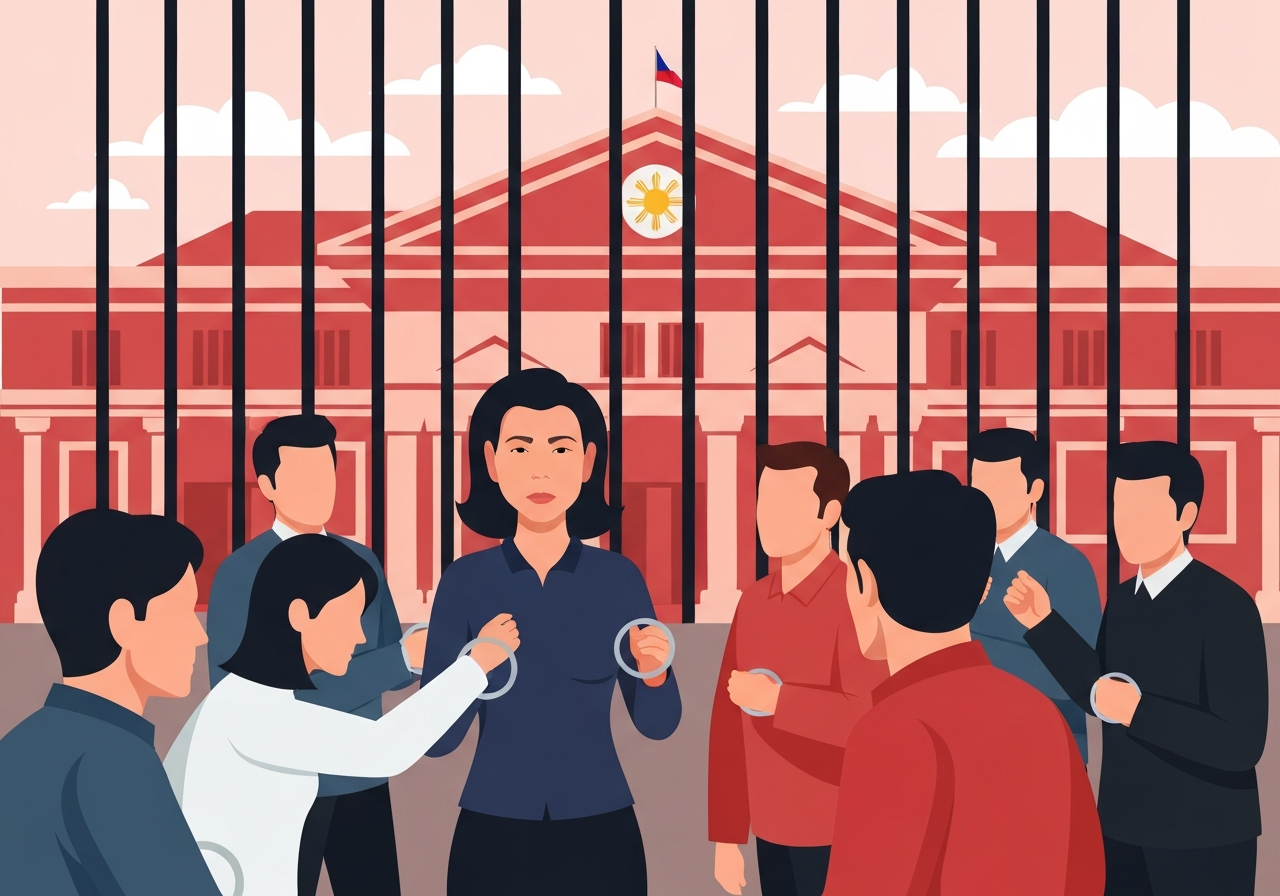
Lead: Vice‑President Sara Duterte’s impeachment trial opened in the Philippine Senate on the morning of the hearing, with heavy security and street protests in Manila. Senators convened to hear opening procedures after a protracted debate over who should preside; the prosecution must secure two‑thirds of the 24‑member Senate — 16 votes — to convict. Authorities arrested at least one key Duterte ally hours before the session, and thousands of police were deployed around the Senate as demonstrators gathered outside. The outcome remains uncertain in a deeply divided chamber and a polarized public arena.
Key takeaways
- Conviction requires 16 of 24 senators — a two‑thirds majority — as stated by Senator Francis Escudero.
- The Senate has allowed up to 92 days for the impeachment trial; opening arguments were delayed by procedural debate.
- At least one senator allied with Duterte, Rodante Marcoleta, was arrested hours before the trial on allegations he did not declare 75 million pesos (~$1.2m) in campaign donations.
- Security around the Senate included reports of more than 3,000 police deployed and several road closures in central Manila ahead of proceedings.
- Protests outside the Senate were sizeable, including demonstrations by supporters of Iglesia ni Cristo, whose membership was estimated at about 3 million (2.6% of the population in the 2020 census).
- Twenty‑one of 24 incumbent senators were present at the opening session; senators must weigh evidence under the prosecution’s burden of proof.
- Livestreams and watch parties have drawn tens of thousands of viewers nationwide, reflecting intense public interest ahead of the 2028 presidential contest.
Background
The trial is rooted in a swift deterioration of the political alliance that brought President Ferdinand “Bongbong” Marcos Jr. and Vice‑President Sara Duterte to power in May 2022. The pair ran on a joint ticket but relations have frayed amid mutual accusations and competing ambitions, with Duterte announcing a 2028 presidential bid in February 2026. Political rivalries have translated into legal and legislative battles between camps in both the House of Representatives and the Senate.
Impeachment in the Philippines places members of the elected Senate in the role of jurors; the House serves as prosecutor. The case against Duterte includes corruption allegations and an allegation she publicly threatened the president. If convicted, she would be disqualified from seeking the presidency in 2028. Campaign finance and alleged threats are central to the charges, which the vice‑president denies as politically motivated.
Main event
The Senate convened for the impeachment court after a long morning of procedural wrangling about who should preside. Senate President Sherwin Gatchalian opened the session and called for “impartial justice,” while senators debated whether the presiding officer should be chosen by the Senate in plenary or by the court itself. After roughly two hours of discussion, Senator Francis Escudero was elected to act as the presiding officer for the trial.
With the presiding question settled, prosecution and defence teams introduced themselves and the court began to move toward formal opening statements. Senators were repeatedly reminded that the burden of proof lies with the prosecution and that any conviction must secure 16 votes. The chamber was packed with reporters and legal teams, while many Filipinos followed the proceedings via livestream and organized watch parties across the country.
Security was visible and heavy. Media on the ground reported more than 3,000 police deployed in the area, road closures and riot gear staged near the Senate building. Outside, demonstrators marched and a brief “minor altercation” with police was reported near the Manila Film Center; authorities described the incident as a misunderstanding. Protest groups included supporters of Iglesia ni Cristo, who staged large demonstrations in response to the arrest of one of Duterte’s allies.
The arrest of Senator Rodante Marcoleta — detained on allegations he failed to declare 75 million pesos in donations from January 2025 — occurred hours before the first day of trial, removing a potential ally from the impeachment court. BBC reporting and other outlets noted that two senators close to Duterte have been arrested recently on plunder or related charges, and another allied senator is reported to be in hiding and wanted by the International Criminal Court for matters connected to the former president’s drug war.
Analysis & implications
Political: The trial shifts a long‑running power struggle between the Marcos and Duterte political blocs into a courtroom setting that will play out live for a national audience. A conviction would bar Duterte from the 2028 presidential race and reshape alliance calculations in the run‑up to that contest. Even without a conviction, the trial may erode or galvanize public support on both sides, depending on how evidence and procedure are perceived.
Institutional: The Senate is under pressure to balance judicial roles with political identities; senators who will vote as jurors face scrutiny over impartiality. The requirement of a two‑thirds majority and the prosecution’s burden of proof make conviction difficult in a fragmented chamber. Procedural disputes — such as who should preside — have already consumed significant time that could otherwise be used for evidence and testimony.
Security and social stability: Heavy police deployment and mass protests highlight the potential for street unrest. The arrest of key allies mere hours before the opening could both depress allied votes inside the chamber and provoke further demonstrations by mobilized groups such as Iglesia ni Cristo. How authorities manage protests and public access to the trial livestreams will shape public perceptions of fairness and transparency.
International: The trial draws some international attention because it involves figures linked to high‑profile human rights concerns from the previous administration. While the impeachment is a domestic legal and political process, developments may influence foreign investors’ and partners’ perceptions of political stability ahead of the 2028 election cycle.
| Item | Number / detail |
|---|---|
| Senators acting as jurors | 24 total; 16 needed to convict |
| Maximum trial duration | 92 days (Senate‑approved limit) |
| Reported police deployment | ~3,000 officers near Senate |
| Alleged undeclared donations | 75 million pesos (~$1.2m) cited in Marcoleta case |
The table above summarizes threshold figures that will shape the pace and possible outcome of the trial. The two‑thirds voting requirement and the prosecution’s burden of proof are the central legal constraints; meanwhile, security numbers and the timing of arrests are variables that affect political dynamics and public demonstrations around the court.
Reactions & quotes
Key institutional and public voices reacted on opening day, framing the trial in legal and political terms and underscoring the national attention on the proceedings.
“The impeachment trial of Vice President Sara Zimmerman Duterte is hereby called to order.”
Sherwin Gatchalian (Senate President)
“Sixteen of 24 senators, or two‑thirds of the Senate, is required to convict; the burden of proof rests on the prosecution.”
Senator Francis Escudero (Presiding officer of the trial)
“I need to know what this is all about. Who is telling the truth?”
Ride‑hail driver, Manila (local resident speaking to BBC)
Unconfirmed
- Whether the arrests of other Duterte‑aligned senators will produce additional formal charges that directly affect their ability to vote in the impeachment court is not yet confirmed.
- The exact vote‑by‑vote alignments among senators remain uncertain; public reports show a deeply split chamber but final voting patterns are unpredictable.
- Details and accountability around the reported “minor altercation” between protesters and police are still being clarified; official investigations or footage may change the current characterization.
Bottom line
The opening day of Sara Duterte’s impeachment trial set the stage for a high‑stakes, politically charged legal contest that could determine her eligibility for the 2028 presidential race. Procedural disputes and pretrial arrests have already influenced the chamber’s composition and public demonstrations, complicating both legal strategy and political calculation. The two‑thirds conviction threshold and the prosecution’s burden of proof make a guilty verdict difficult in a fragmented Senate, but public reaction to evidence and courtroom management will be decisive in shaping momentum.
Watch points for the coming days include whether the prosecution can assemble persuasive documentary and witness evidence, how many senators are effectively absent or recused at key votes, and whether further arrests or protest escalations alter the political climate. For Filipinos and international observers alike, the process will be a test of institutional resilience and the capacity of legal procedures to manage a fraught political dispute.
Sources
- BBC Live: Sara Duterte impeachment coverage (news media)
- Official Senate of the Philippines (government/official)
- ABS‑CBN News (news media)