
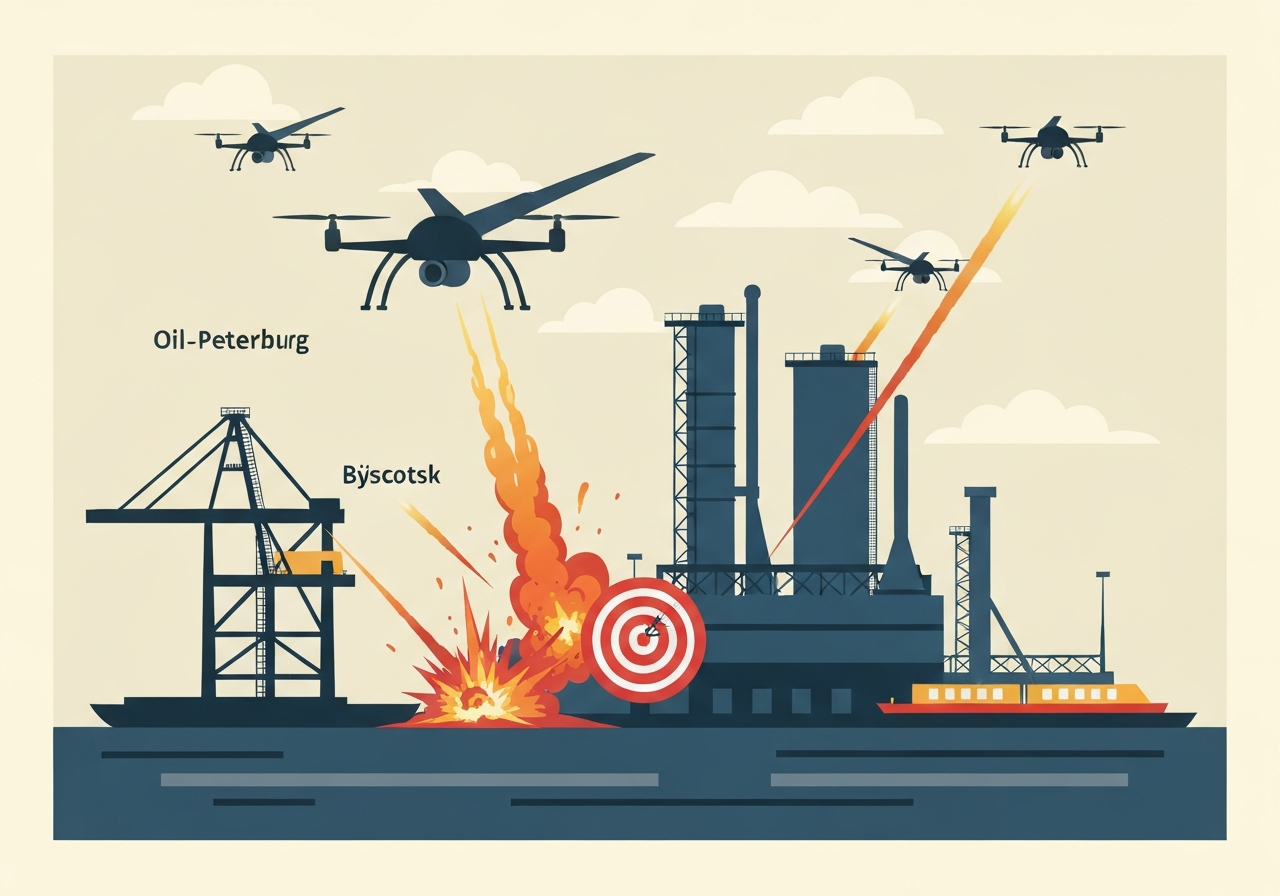
Ukrainian forces launched a large overnight drone operation that struck energy and port infrastructure in and around St Petersburg on 4 July 2026, local and national officials said. St Petersburg governor Alexander Beglov reported damage to the city’s oil terminal but said there were no casualties after emergency crews responded. Leningrad region governor Alexander Drozdenko said a drone hit the Vysotsk port area, and that air defenses had downed dozens of drones across the region. Kyiv framed the operation as part of ongoing long‑range pressure on Russian revenue and military targets.
Key takeaways
- St Petersburg reported damage to its oil terminal; officials said no deaths or major injuries within the city.
- Leningrad region governor said a drone struck Vysotsk port, a Baltic terminal that handles oil, grain, coal and LNG, about 170 km north‑west of the city.
- Authorities reported 72 drones shot down over Leningrad region and more than 30 shot down over Pskov region overnight.
- Regional authorities in Bryansk and Russian‑installed officials in Crimea reported one fatality in each region with several wounded.
- President Volodymyr Zelenskyy described the strikes as “long‑range sanctions” targeting revenue and military infrastructure, including a claimed hit on Kronstadt more than 850 km from Ukraine’s border.
- Russian officials, including President Vladimir Putin, downplayed the impact; the Kremlin did not independently confirm a strike on Kronstadt.
- Ukraine has stepped up strikes on Russian energy infrastructure this year, contributing to refinery damage and fuel shortages across large parts of Russia.
Background
Since early 2026 Kyiv has intensified long‑range attacks on infrastructure it says funds Moscow’s war effort and supports military logistics. Targets have included refineries, pipelines and port facilities; several major incidents earlier this year contributed to fuel distribution problems across Russia’s 11 time zones. Ukraine says disabling revenue‑generating energy nodes is a legitimate part of its campaign to weaken Russia’s ability to sustain frontline operations. Moscow frames those strikes as terrorism or sabotage and has sought to limit public concern by emphasizing air defenses and rapid repairs.
The geography of the latest operation matters: St Petersburg and the surrounding Leningrad region are both industrially significant and home to naval facilities, while Vysotsk is a commercial port handling hydrocarbon and dry‑bulk cargoes on the Baltic Sea. Kronstadt, a major naval base near St Petersburg, was named by Kyiv as another target; strikes against distant military sites reflect Kyiv’s growing use of long‑range systems. Governors and regional administrations remain primary sources for immediate damage and casualty figures, while central ministries provide broader military claims and counters.
Main event
Officials reported the assault began overnight on 4 July 2026. St Petersburg governor Alexander Beglov said a “large‑scale” drone attack struck the city’s oil terminal; he added that emergency services had dealt with the aftermath and that there were no casualties reported in the city. Leningrad governor Alexander Drozdenko said at least one drone hit the Vysotsk port area roughly 170 km north‑west of St Petersburg, a facility that handles oil, grain, coal and liquefied natural gas.
Drozdenko reported that air defenses in the Leningrad region intercepted 72 drones; Pskov regional authorities separately said they shot down more than 30 drones overnight, with minor damage and some injuries in scattered settlements. Officials in Russia’s Bryansk region and in Russian‑administered Crimea reported one fatality apiece from separate drone strikes and several wounded, indicating the operation affected multiple fronts beyond the immediate St Petersburg area.
Kyiv’s general staff and President Volodymyr Zelenskyy described the strikes as deliberate actions targeting infrastructure that provides revenue or strategic value to Russia. Zelenskyy said in public comments that the operation struck port oil infrastructure and, he claimed, hit Kronstadt — a naval target more than 850 km from Ukraine’s state border. The Kremlin and Russia’s defence ministry disputed or downplayed aspects of the reports; President Putin described the strikes on energy facilities as “not critical.” Russia did not provide an independent confirmation of a Kronstadt hit.
Analysis & implications
The immediate military logic is twofold: to deny revenue streams that finance warfare and to degrade logistical nodes that support Russia’s naval and export capacity. Vysotsk’s role as a multi‑commodity port means damage there could reverberate through both energy and agricultural export channels, depending on the extent of damage and repair times. Even limited disruptions at coastal terminals can cause rerouting, delays and short‑term price effects for shipments bound for international markets.
Strategically, Kyiv’s use of long‑range drones and missiles to strike deep into Russian territory signals a maturation of strike capabilities and a willingness to target economic infrastructure in addition to battlefield targets. That creates political and logistical costs for Moscow: increased air‑defense expenditures, accelerated repairs, and potential domestic pressure over shortages and price spikes. For Ukraine, the tactic imposes risk of retaliation and raises the stakes for escalation dynamics in and around contested regions.
Domestically within Russia, officials play a dual role—assuring the public that air defenses are effective while managing narratives about damage and casualties. Internationally, repeated strikes on energy facilities complicate the energy markets and may prompt further sanctions or diplomatic moves by third‑party countries concerned about supply stability. The long‑term effectiveness of targeting revenue infrastructure depends on repair capacity, alternative export routes, and the willingness of insurers and shippers to continue operations in the affected areas.
Comparison & data
| Region | Reported drones shot down | Reported casualties/damage |
|---|---|---|
| Leningrad region | 72 | Damage to St Petersburg oil terminal; Vysotsk area struck (impact on port unreported) |
| Pskov region | More than 30 | Minor damage; injuries reported, including at a factory in Velikiye Luki |
| Bryansk / Crimea | Not specified | One fatality reported in each region; several wounded |
The regional tallies underline the scale of the interception effort but do not by themselves prove operational success against every intended target. Official counts of downed drones are often preliminary; they reflect local air‑defense claims and may be revised. Damage to infrastructure such as terminals typically requires on‑site assessments to determine repair timelines and economic impact, and those assessments have not yet been published by independent bodies.
Reactions & quotes
Kyiv framed the strikes as targeted pressure on revenue and military capacity. In a public post President Zelenskyy said the operation struck port oil infrastructure and named Kronstadt as an additional military target.
“Ukraine’s defence forces struck port oil infrastructure that generates revenue for Russia’s war, and also hit Kronstadt, an important military target more than 850 km from Ukraine’s state border.”
Volodymyr Zelenskyy, President of Ukraine (public post)
The Kremlin emphasized defensive resilience and minimized strategic consequence. President Putin described strikes on energy facilities as limited in effect.
“Not critical.”
Vladimir Putin, President of the Russian Federation (statement)
Local governors offered operational details about interceptions and damage while emergency services reported containment of major fires in the city. Leningrad and St Petersburg authorities supplied the bulk of the immediate incident data used in this article.
Unconfirmed
- Independent confirmation of a strike on Kronstadt has not been provided; Russian authorities did not corroborate Kyiv’s claim.
- The extent of damage to Vysotsk port and its operational impact on oil or grain shipments has not been independently verified.
- Casualty and damage tallies across several regions remain preliminary and may be revised as investigations continue.
- Some Russian claims of village captures in eastern Ukraine reported by the defence ministry have not been independently confirmed by neutral observers.
Bottom line
The 4 July drone operation shows Kyiv’s increasing capacity to reach energy and naval infrastructure deep inside Russian territory, and it highlights the strategic shift toward striking revenue‑generating assets as part of a broader pressure campaign. While regional authorities reported dozens of intercepts and localized damage, many central claims—especially regarding hits on distant naval facilities—remain unverified by independent sources.
The wider implications are twofold: immediate logistical disruption for exports and an escalation of resource commitments for Russian air defence and repairs. Expect further official statements, satellite analysis and third‑party verification in the coming days; those sources will be crucial to assess the operation’s true economic and military effects.
Sources
- The Guardian — international news media report with regional official statements.
- Office of the President of Ukraine — official statements and public posts (government/official).
- St Petersburg Governor’s Office — regional government statements (official).
- Leningrad Region Administration — regional government reporting (official).
- Russian Ministry of Defence — defence ministry claims and situational reports (official).