
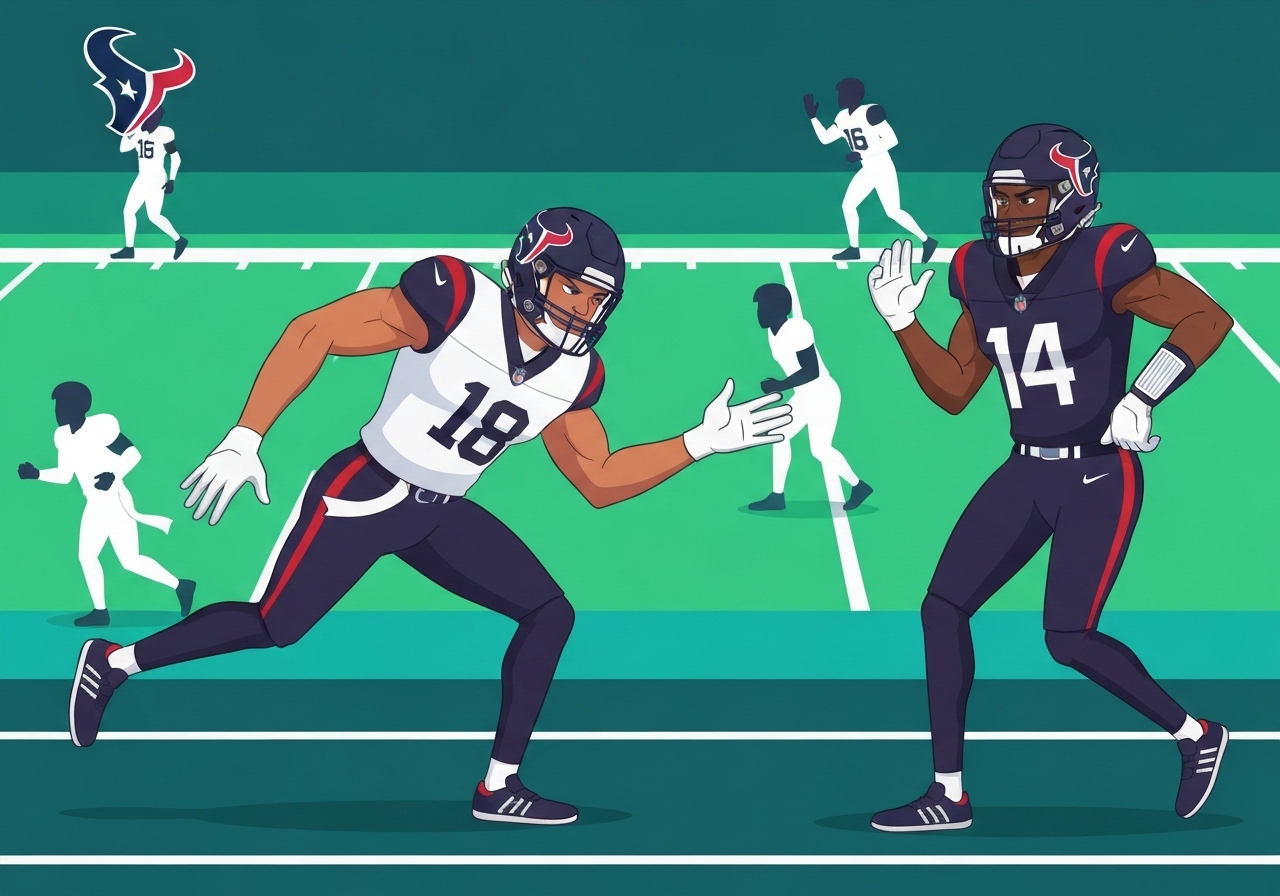
Nov. 20, 2025 — Through a chaotic first half in Houston, the Texans held a 20-16 lead over the Buffalo Bills at halftime after a flurry of scoring and key turnovers. James Cook opened the scoring with a 45-yard touchdown run that pushed him past 1,000 rushing yards for the season, but special-teams miscues and a tipped interception swung momentum. Houston answered with a pair of red-zone scores and a 97-yard kickoff return by Ray Davis, while Josh Allen took a hard hit that briefly removed him from the field. The game entered the break as a fast-paced shootout with several injury questions and a number of game-changing plays.
Key Takeaways
- Halftime score: Texans 20, Bills 16 after two minutes of late first-half scoring produced 24 combined points.
- James Cook had a 45-yard touchdown run and surpassed 1,000 rushing yards for the season; Buffalo’s team rushing average entering the game was 147.6 yards per game.
- Ray Davis returned the ensuing kickoff 97 yards for a Texans touchdown that cut into Buffalo’s lead before Houston closed the half ahead.
- Calen Bullock intercepted Josh Allen off an Azeez Al-Shaair tip; the return for a touchdown was nullified by a block-in-the-back penalty.
- Davis Mills finished the half 11-for-21 for 122 yards and two touchdown passes, including the final 8-yard score to Jayden Higgins with five seconds remaining.
- Will Anderson Jr. recorded another sack, marking his ninth sack of the season and a multi-game sack streak that ranks among the longest in Texans history.
- Key injuries: Josh Allen left briefly after a heavy hit but walked off; Bills LT Dion Dawkins entered the medical tent for a concussion evaluation; several role players on both teams were evaluated during the half.
Background
Thursday Night Football often produces erratic, high-energy contests where momentum swings quickly, and this Week 12 matchup followed that pattern. Buffalo arrived with the NFL’s top rushing attack, averaging 147.6 yards per game, while Houston entered with one of the league’s stingiest run defenses, allowing 3.9 yards per carry. That juxtaposition — a dominant rushing offense against a stout interior defensive front — set up a matchup of strengths that influenced playcalling and early-game aggressiveness.
Buffalo’s injury report left its receiving corps thin: Curtis Samuel, Dalton Kincaid and Mecole Hardman were out, with Keon Coleman again a healthy scratch and Gabe Davis elevated from the practice squad. Houston was without starters C.J. Stroud and Jalen Pitre (both concussions) and Jamal Hill (hamstring), meaning Davis Mills and Houston’s defensive playmakers shouldered larger roles.
Main Event
The Bills struck first when James Cook burst for a 45-yard touchdown on a third-and-inches, a run that also pushed him over 1,000 rushing yards for the season. Buffalo’s Matt Prater missed the extra point, leaving the score 6-0 and making every subsequent possession more consequential. Houston responded with a Ka’imi Fairbairn field goal, then took its first lead when Davis Mills connected with Christian Kirk on a 2-yard touchdown.
Immediately after that score, the game swung on turnover and special-teams plays. Josh Allen’s deep target was tipped by Azeez Al-Shaair and intercepted by Calen Bullock; Bullock’s return appeared to be a touchdown but was negated by a block-in-the-back penalty. Houston settled for three points on the ensuing drive, and on the kickoff Ray Davis returned it 97 yards for a touchdown, briefly giving Buffalo a counterpunch and shifting momentum back to Houston’s sideline.
Late in the half Mills engineered a decisive two-minute push highlighted by a 33-yard Christian Kirk catch-and-run, finishing with an 8-yard touchdown to Jayden Higgins with five seconds left. That sequence put Houston ahead 20-16 at the break. Between those drives, Bills’ ball security and injury issues — including a Khalil Shakir fumble recovered by Justin Reid after a Calen Bullock forced the loose ball — shaped the half’s narrative.
Analysis & Implications
The first-half action reinforced a central strategic matchup: Buffalo’s elite rushing attack versus Houston’s stout run defense. Cook’s big run showed Buffalo can still create explosive plays on the ground, but Buffalo’s missed extra point and several stalled possessions left points on the board and handed momentum to Houston. If the Bills cannot convert red-zone opportunities into touchdowns, they risk being outpaced in a game built on explosive plays.
Houston’s offense has relied on a push up front in the run game to create play-action windows for Davis Mills. Mills’ two touchdown passes came after effective ground gains and a pivotal 33-yard completion; sustaining that balance will be crucial in the second half given the Bills’ tendency to funnel plays to the surface. Conversely, Houston’s red-zone challenges — a season-long trend — could still hamper how much they score when drives stall inside the 20.
On defense, Will Anderson Jr.’s impact remains decisive. His pressure and sack production force opposing play-callers to adjust protections and shorten the field for passing attempts. Buffalo’s offensive tackles and remaining personnel will need to handle sustained edge pressure; otherwise, Buffalo may struggle to establish a rhythm through the air in the second half.
Comparison & Data
| Metric | Buffalo | Houston |
|---|---|---|
| Team rushing yards per game | 147.6 | — (Texans allow 3.9 YPC) |
| James Cook rushing avg | 96.8 YPG | — |
| Texans run defense | — | 3.9 yards per carry allowed |
| Will Anderson Jr. sacks | — | 9 sacks, 6-game sack streak |
The table underscores why this game has been defined by the run/pass trade-offs: Buffalo’s season-long ground production contrasts with Houston’s season-long ability to limit per-carry gain. Individual matchups — interior blocking for Buffalo and edge pressure for Houston — have driven the biggest plays so far.
Reactions & Quotes
“What a dominant effort from the Houston defensive line.”
CBS Sports (live updates)
That live-call captured how the Texans’ front disrupted Buffalo’s interior runs on several drives, especially late in the first half. The push up front created opportunities for play-action and helped generate pressure on Josh Allen.
“What a turn of events!”
CBS Sports (live updates)
This exclamation referred to the swift sequence of turnover, nullified return and then a 97-yard kickoff return that swung momentum and produced rapid scoreboard changes before halftime.
“This is what the Texans do: play aggressively and make things really tough on opposing quarterbacks.”
CBS Sports (live updates)
The description reflects Houston’s game plan of tipping and forcing turnovers; the interception by Calen Bullock (off an Azeez Al-Shaair tip) exemplifies that strategy even when the immediate return was negated by penalty.
Unconfirmed
- Final severity and game status for Josh Allen after his halftime hit remain pending official concussion protocol results.
- Dion Dawkins’ concussion evaluation outcome is not yet official; his return is dependent on medical clearance.
- Some in-game stat totals and sack counts are subject to official review and could be adjusted postgame.
Bottom Line
The first half in Houston produced a tightly contested, high-variance game built on big plays, turnovers and special-teams impact. Buffalo’s ground game remains a threat, but missed extra points and turnovers have given Houston life. Davis Mills and Houston’s offense have capitalized on sudden swings, while Houston’s defense has made several momentum-changing plays.
Second-half dynamics will hinge on injury reports (particularly for Josh Allen and Dion Dawkins), Buffalo’s ability to sustain drives for touchdowns rather than settling for field goals, and whether Houston can translate its red-zone possessions into touchdowns. Expect adjustments from both coaching staffs and a continuation of the all-or-nothing style that defined the first two quarters.
Sources
- CBS Sports — Live updates and game coverage (media: live reporting)
- NFL.com — Official statistics and injury reports (official league data)
- Pro-Football-Reference — Historical and season statistics (statistics database)