
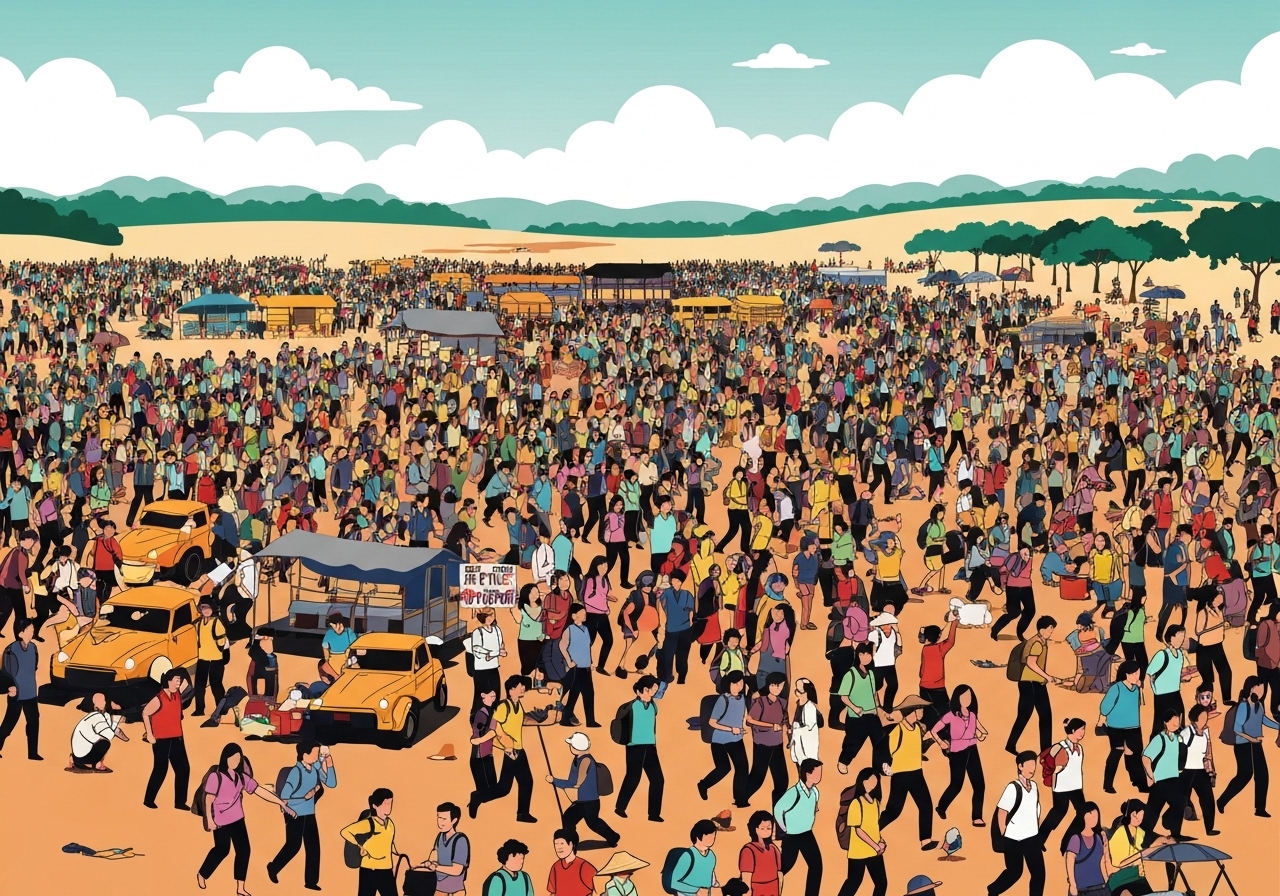
Fresh clashes along the Thailand–Cambodia frontier on Wednesday forced more than 500,000 people into temples, schools and ad hoc shelters after fighting involving jets, tanks and drones erupted near contested temple sites. Officials from both countries reported at least 15 dead, a figure that includes Thai soldiers and Cambodian civilians, as evacuation convoys streamed away from the line. Cambodia and Thailand traded accusations over who reignited the violence; U.S. President Donald Trump said he would call both leaders and sought to broker a rapid de-escalation. Local authorities imposed curfews and widened shelter operations amid mounting concern for civilian safety.
Key takeaways
- More than 500,000 people have been displaced along the 800km border, with sheltering in pagodas, schools and temporary camps reported across five provinces of both countries.
- At least 15 people were killed in the latest clashes, including Thai soldiers and Cambodian civilians; Cambodia later reported 10 civilian deaths and said an infant was among the dead.
- Thailand’s defence ministry reported over 400,000 civilians evacuated into shelters; Cambodia reported over 101,000 people in shelters or with relatives.
- Officials said combat involved jets, tanks and drones near disputed temple sites such as Ta Krabey and areas close to Phanom Dong Rak hospital in Surin province.
- President Trump said he would phone both heads of state and expressed confidence he could help end the hostilities quickly; regional mediation by the U.S., China and Malaysia had helped secure a July truce.
- Thailand imposed an overnight curfew from 19:00 to 05:00 in parts of Sa Kaeo province beginning Wednesday night to limit movement amid the fighting.
- Cambodia withdrew its team from the Southeast Asian Games in Thailand, citing safety concerns for athletes.
Background
The border dispute between Thailand and Cambodia dates to colonial-era maps and competing claims over temple complexes close to the frontier. The 800km (500-mile) boundary has been a recurring flashpoint, with competing national narratives about historic sites turning territorial claims into sources of domestic political pressure. In July, five days of heavy fighting killed dozens before a truce—brokered with help from the U.S., China and Malaysia acting within ASEAN channels—temporarily eased tensions.
Since the summer ceasefire, the situation has been fragile: leaders signed a joint declaration in October to extend the truce and link it to economic cooperation, but Bangkok suspended that agreement the following month. Local communities along the frontier, many dependent on farming and cross-border trade, have faced repeated displacements; farmers and temple communities report recurring disruptions to livelihoods and access to medical care. Military posturing on both sides has kept forces near disputed sites and raised the risk that small incidents could rapidly escalate.
Main event
Wednesday’s escalation began with renewed exchanges of fire near multiple border points, eyewitnesses and officials said, and rapidly spread into at least five provinces on both sides. Residents described jets and ground fire that sent families fleeing into temple precincts and school compounds; one evacuee said authorities warned that temple grounds were no longer safe after aircraft activity close by. Local police and defence spokespeople reported that rockets and artillery were used and that frontline hospitals and community structures were affected by nearby strikes.
Thai authorities implemented sheltering programs and announced a curfew in parts of Sa Kaeo province from 19:00 to 05:00 to reduce civilian movement while troops secured evacuation routes. Cambodian officials reported that Ta Krabey temple and nearby civilian areas were hit and accused Thai forces of indiscriminate shelling; Thai forces countered that Cambodian units fired rockets that landed near Phanom Dong Rak hospital in Surin province. The flow of displaced persons included elderly farmers, children and those who said they had left medication and possessions behind.
By midweek, officials estimated more than 400,000 people had been moved into Thai shelters and over 101,000 were displaced inside Cambodia to relatives’ homes and formal centres. The two governments blamed each other for breaking the earlier truce; both sides have increased military alerts, and Cambodia announced withdrawal from the Southeast Asian Games in Thailand, citing the security environment for its athletes. International actors signalled concern and said they were monitoring the situation closely.
Analysis & implications
The immediate humanitarian consequence is large-scale displacement across a compact border region where social and economic ties cross national lines. Repeated evacuations strain local shelter capacity and public services, creating secondary crises around health, sanitation and chronic disease management—especially for older residents who reported leaving medicines behind. Sustained insecurity could disrupt rice and sugarcane harvests in frontier provinces, depressing local incomes and increasing pressure on national relief budgets.
Politically, the clashes expose the limits of the July truce and the fragility of agreements that lack strong verification mechanisms and local confidence-building. Bangkok’s suspension of the October agreement and the mutual recriminations reduce incentives for immediate face-to-face negotiations. External mediation will be politically sensitive: Thailand’s foreign ministry said it could not accept third-party mediation at this stage, citing trust deficits after civilian deaths, while Cambodia has pressed international partners to condemn what it described as indiscriminate fire.
Regionally, renewed fighting risks drawing in ASEAN diplomatic channels and could complicate great-power engagement. The U.S. has signalled willingness to intervene diplomatically; China and other ASEAN members are likely to push for a return to negotiation to preserve regional stability and trade continuity. If hostilities continue, spillover effects could include higher refugee burdens in provincial towns, disruptions to cross-border commerce, and greater international calls for an enforceable ceasefire mechanism.
Comparison & data
| Category | Thailand (reported) | Cambodia (reported) |
|---|---|---|
| Displaced people | ~400,000+ | ~101,000+ |
| Reported fatalities (latest) | Included Thai soldiers among 15 total | 10 civilians reported |
| Provinces affected | Sa Kaeo, Surin and others (total five) | Several northwestern provinces (total five) |
The table summarises government statements made during Wednesday’s updates. Numbers reflect official tallies reported by Thai and Cambodian spokespeople; independent verification by third-party monitors was limited at the time of reporting. Past intense episodes—most recently in July—saw days of heavy combat and a pause negotiated by outside actors, illustrating a pattern of flare-ups followed by temporary pacts rather than a lasting settlement.
Reactions & quotes
International and local reactions were immediate: leaders and agencies stressed the urgency of protecting civilians and reopening diplomatic channels.
I will be speaking to both leaders and I think I can get them to stop fighting pretty quickly.
U.S. President, press comments reported
Context: President Trump told reporters in Washington that he planned calls with the leaders of Thailand and Cambodia and expressed confidence in brokering a prompt halt to fighting. His statement follows prior U.S. engagement in July that helped secure a brief truce.
The Thai army reported that rockets landed in the area of Phanom Dong Rak hospital and warned of ongoing threats to civilian areas.
Thai defence ministry (official statement)
Context: Thai defence spokespeople described strikes near a frontline hospital in Surin province and outlined mass evacuations into shelters. The ministry said more than 400,000 civilians had been moved to safer locations.
Cambodia says its sacred site at Ta Krabey was shelled and that civilians, including children, were killed.
Cambodia defence ministry (official statement)
Context: Cambodian officials accused Thai forces of shelling temple grounds and civilian zones, reporting 10 civilian fatalities and calling the site a sacred cultural asset. Both governments’ claims remain contested on the ground.
Unconfirmed
- Attribution of specific strikes: claims that particular artillery rounds or airstrikes originated from a named unit on either side remain unverified by independent monitors.
- Exact civilian casualty breakdown: while officials reported 15 deaths and Cambodia later gave 10 civilian fatalities, full lists and medical confirmations have not been independently published.
- Damage assessments for specific cultural sites such as Ta Krabey temple and Phanom Dong Rak hospital await verified on-site surveys to confirm the extent of structural harm.
Bottom line
The immediate priority is humanitarian: hundreds of thousands require shelter, medical care and secure corridors to receive aid while hostilities continue. Without credible, verifiable mechanisms to monitor a ceasefire and protect civilians, temporary truces are likely to be fragile and punctuated by renewed violence. The scale of displacement increases the urgency for both sides to allow neutral humanitarian access and for regional actors to press for de-escalation.
Diplomatic moves—including the U.S. offering to intervene and ASEAN’s prior role—could help produce a rapid pause, but a lasting solution will require negotiated, enforceable steps to settle contested border demarcation and protect cultural sites while addressing the local humanitarian and economic fallout. Observers should watch upcoming leader-level talks, verification arrangements, and commitments to sustain relief operations in affected provinces.
Sources
- The Guardian — international news outlet reporting the incident (media)
- Agence France-Presse (AFP) — international news agency with on-the-ground reporting (news agency)
- ASEAN — regional bloc and previous mediator in July truce (regional organization)
- White House Briefing Room — U.S. administration statements and press briefings (official)