
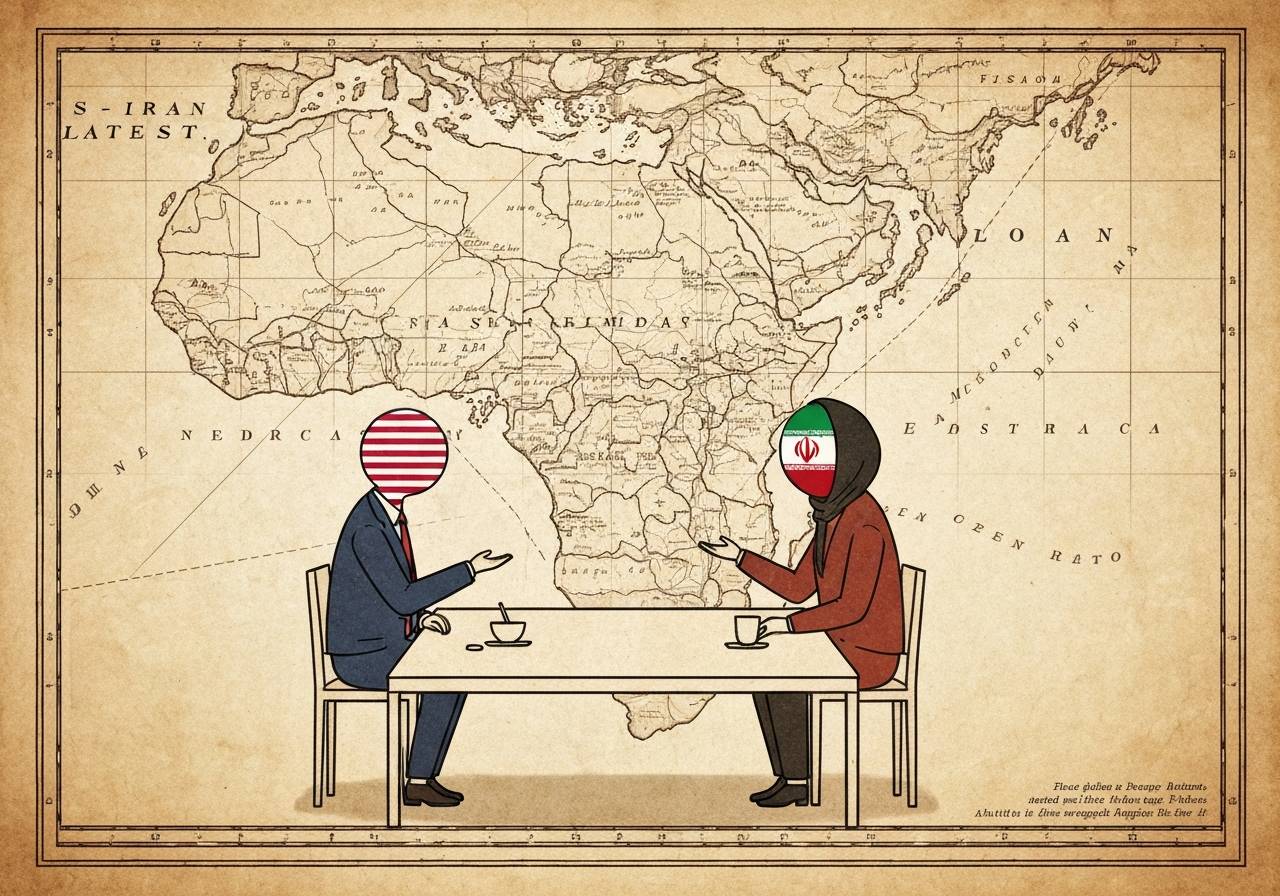
Lead: U.S. and Iranian officials resumed indirect technical talks in Doha this week, mediated by Qatari and Pakistani intermediaries, as President Trump described the meetings as “very good.” Delegations are focused on the release of frozen Iranian assets and security arrangements around the Strait of Hormuz, and the talks follow direct discussions at the Lake Lucerne summit. Parallel developments — from a U.S. Navy helicopter emergency water landing in the Arabian Sea to shipping unions keeping the Strait of Hormuz designated a war zone — underscore the fragile regional picture.
Key Takeaways
- Indirect technical talks between the U.S. and Iran resumed in Doha on July 1, mediated by Qatar and Pakistan, building on the Lake Lucerne summit outcomes.
- Tehran reportedly seeks staged release of frozen funds beginning with $6 billion held in Qatari banks; Washington has proposed use restrictions tied to a U.S. credit line, which Iran has rejected.
- Three crew members of an MH-60S Sea Hawk assigned to USS George H.W. Bush were rescued and are in stable condition after an emergency water landing in the Arabian Sea; one crewman remains missing.
- The International Bargaining Forum continues to label the Strait of Hormuz a “warlike operations area” through at least July 9, covering roughly 15,000 signatory vessels and preserving double pay and repatriation rights.
- Iran’s negotiator Mohammad Bagher Ghalibaf said Iran has exported more than 40 million barrels of oil since the U.S. blockade was lifted; he contrasted that with an asserted 50–60 day period during which Iran exported no oil.
- The EU Aviation Safety Agency extended its advisory through July 8, urging airlines to avoid airspace over Iran, Iraq and Lebanon amid concerns about the ceasefire’s durability.
- Political leaders signaled divergent priorities: Trump emphasized progress on denuclearization, while some Iranian hardliners continue to voice strong reservations about the memorandum of understanding.
Background
The diplomacy stems from a wider de-escalation effort after exchanges of fire last week and a high-profile direct meeting in Switzerland known as the Lake Lucerne summit. Under a memorandum of understanding signed by both sides, officials agreed technical talks would proceed indirectly: mediators convey proposals rather than U.S. and Iranian envoys negotiating face-to-face. That approach aims to reduce the political risk of direct contact while still advancing narrow, verifiable steps.
Economic levers — chiefly frozen overseas assets and sanctions relief — sit at the center of the negotiations. Iran wants access to funds that could support imports of essentials such as food and medicine, while U.S. proposals reportedly include mechanisms to limit how released funds are spent. The Strait of Hormuz, where shipping and military incidents have stoked international alarm, remains a focal point for both security arrangements and commercial risk calculus.
Regional actors and intermediaries, including Qatar and Pakistan, have taken visible roles as facilitators. International labor and shipping groups have reacted to security trends by maintaining warlike-area designations that raise operating costs for carriers, while aviation authorities continue to advise rerouting over specific Middle East corridors.
Main Event
Diplomats familiar with the Doha sessions said the talks began Tuesday night and continued into Wednesday, with agendas that included the phased release of frozen Iranian funds and operational guarantees for safe maritime passage. Iran reportedly requested funds be released in two phases over a 60-day period, starting with $6 billion held in Qatari banks; Washington has pushed for safeguards that would limit use of some funds to purchases such as U.S. agricultural commodities, a proposal Iran has resisted.
President Trump, speaking at Joint Base Andrews on Wednesday before departing for North Dakota, described the Doha meetings as “very good” and said denuclearization was “moving along well.” He repeated a line that Iran had “come a long way,” while also noting the U.S. had struck Iran hard when necessary. Tehran, meanwhile, publicly framed the MoU as a diplomatic win in some quarters and as insufficient in others.
On the same day, U.S. Naval Forces Central Command reported an MH-60S Sea Hawk from USS George H.W. Bush made an emergency water landing in the Arabian Sea; three of four crew members were recovered and listed stable aboard the carrier, with searches continuing for the remaining airman. Military officials said there was no indication the helicopter had been shot down by hostile action.
Commercial and labor stakeholders have reacted to ongoing instability. The International Bargaining Forum’s labor agreement — signed by shipping employers and unions covering about 15,000 vessels — keeps the Strait of Hormuz designated as a warlike operations area through at least July 9, granting seafarers double pay and repatriation rights and raising operational costs for shipowners.
Analysis & Implications
The indirect format reduces political heat by shielding negotiators from direct headline-grabbing encounters, but it slows information flow and adds friction: mediators must accurately transmit proposals and safeguards. That dynamic makes implementation and verification more complex and raises the risk that misunderstandings or domestic political pushback on either side could derail progress.
Financial terms are central. Iran’s demand for unfettered control of released assets conflicts with U.S. concerns about diversion and oversight. A compromise that combines staged transfers with transparent auditing and humanitarian carve-outs could bridge positions, but it will require trust in monitoring mechanisms and credible penalties for breaches — a difficult prospect after years of sanctions and mutual suspicion.
Security arrangements around the Strait of Hormuz are both symbolic and substantive. Continued attacks on vessels and the retention of warlike-area status by unions increase insurance and crewing costs, which ripple through global shipping rates. If the ceasefire proves durable, de-escalation could gradually lower those premiums; if not, higher costs and operational restrictions will likely persist.
Politically, both sides face domestic audiences skeptical of concessions. Hardliners in Iran have already criticized the MoU, and U.S. officials must assuage concerns about concessions that could be portrayed as rewarding malign behavior. The interplay of domestic politics, regional proxy dynamics, and international economic pressures makes the talks fragile but consequential.
Comparison & Data
| Period | Reported Iranian Oil Exports |
|---|---|
| During U.S. blockade (approx. prior 50–60 days) | Reportedly near 0 barrels |
| Since blockade lifted (to June/July 2026) | Reported >40 million barrels |
The negotiator’s figures aim to demonstrate the magnitude of Iran’s regained export capacity after sanctions relief. Independent verification of exact daily export rates requires shipping manifests and tanker-tracking datasets; the reported milestone of more than 40 million barrels indicates a rapid recovery in volumes compared with the asserted pause during the blockade.
Reactions & Quotes
“They’ve had very good meetings, and we’ll see.”
President Donald Trump
Trump framed the Doha sessions as constructive, emphasizing progress on denuclearization while maintaining a tough posture when describing prior U.S. actions.
“From the day the blockade was lifted until today, we have exported more than 40 million barrels of oil.”
Mohammad Bagher Ghalibaf, Iran chief negotiator
Ghalibaf used export figures to argue the MoU had yielded economic benefits for Tehran, contrasting current shipments with the period he said Iran could export virtually nothing under blockade.
“This decision recognises the continuing and significant risk to life and the rapidly evolving situation in the area.”
International Transport Workers’ Federation / Joint Negotiating Group (joint statement)
The unions and employer group justified maintaining the Strait of Hormuz warlike-area designation on safety and risk grounds, citing recent attacks and casualties at sea.
Unconfirmed
- The precise terms and timetable for any final agreement on frozen assets remain under negotiation and publicly unverified.
- Details about the cause of the MH-60S emergency water landing — mechanical failure, weather, or other factors — have not been publicly confirmed.
- Claims about the exact number of mourners (15–20 million) expected at the state funeral are projections by Iranian officials and cannot be independently verified in advance.
Bottom Line
The Doha technical talks represent a cautious, incremental step toward easing U.S.-Iran tensions, focusing on verifiable, technical issues such as frozen assets and maritime safety rather than broad political normalization. The indirect format reduces headline risk but heightens dependence on mediators and monitoring mechanisms to translate tentative agreements into durable outcomes.
Success will depend on concrete verification measures, phased confidence-building steps, and the willingness of both sides to accept partial, reversible actions that can be scaled up if compliance is verified. Meanwhile, operational risks at sea and continuing domestic political pressures in Washington and Tehran make the path forward uncertain.