
Lead
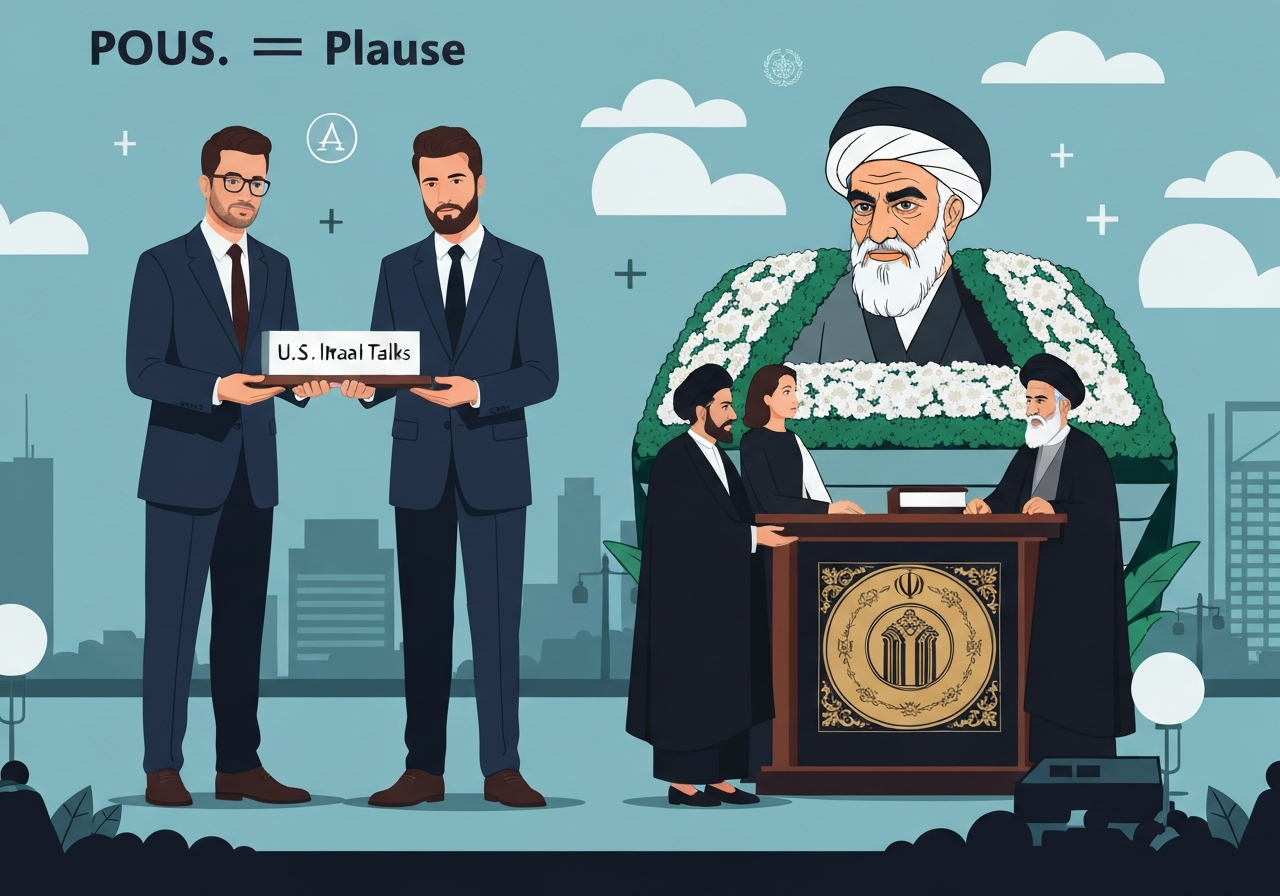
U.S. and Iranian negotiators have put indirect talks on hold for at least a week as Iran prepares state funeral ceremonies for the slain supreme leader Ayatollah Ali Khamenei, scheduled to begin July 4. Mediators from Qatar and Pakistan and President Trump said this week’s Doha sessions yielded “positive progress,” while U.S. leaders and analysts differ on how much substantive ground was covered. The pause follows only two formal engagements since the June 17 memorandum of understanding, which set a 60-day target to reach a broader end-of-war agreement. Key questions remain about whether the nuclear file and contentious issues such as control of the Strait of Hormuz were meaningfully addressed.
Key Takeaways
- Talks paused: Indirect U.S.-Iran negotiations in Doha have been suspended for at least a week for funeral events beginning July 4 for Ayatollah Ali Khamenei.
- Progress claimed: Qatar and Pakistan mediators and President Trump described the Doha meetings as showing “positive progress” on matters tied to the June 17 MoU.
- 60-day clock: The MoU committed both sides to a final deal in a “maximum 60 days,” a period described as extendable by mutual consent; only two engagement days have occurred so far.
- Strait of Hormuz prioritized: Negotiators appear to have emphasized future administration of the Strait with Oman, while deep nuclear issues may have been deferred.
- Nuclear stockpile: Iran holds about 900 pounds of highly enriched uranium; experts say down-blending would slow but not eliminate a long-term weapons pathway.
- Shipping rebound: Transit through the Strait of Hormuz rose to 258 ships last week from 138 the prior week but remains far below pre-war levels (~130 ships daily).
- Funeral scale: Iranian officials expect 15–20 million mourners across six days of ceremonies in Tehran, Qom, Mashhad and two Iraqi holy cities.
- Security incidents: Negotiations and diplomacy continue under the shadow of recent strikes, regional naval incidents and an ongoing search for a missing U.S. airman after a helicopter emergency landing in the Arabian Sea.
Background
The memorandum of understanding signed on June 17 committed the United States and Iran to negotiate a final settlement to end the war within a 60-day window, extendable with mutual consent. The MoU lists 14 points including cessation of hostilities, administration of the Strait of Hormuz, and steps related to Iran’s nuclear materials. So far the two sides have engaged twice: a direct meeting in Switzerland on June 21 and indirect mediator-led talks in Doha in late June/early July. Each side has offered differing accounts in public remarks about what was agreed, and mediators from Qatar and Pakistan have acted as interlocutors for the limited contacts.
Domestic pressures shape both capitals’ approaches. In Washington, the administration faces calls to prevent Iran from acquiring a nuclear weapon while restoring secure shipping through the Strait to stabilize global energy markets. Tehran confronts economic strains and political incentives to solidify control of the Strait and win sanctions relief. Regional players — Oman, Saudi Arabia, Gulf states, and Iraq — have overlapping security and commercial interests, with Oman already in talks with Iran over future administration of the waterway.
Main Event
Negotiations in Doha this week were indirect and short, according to officials and mediators. Qatari and Pakistani spokespeople issued a joint statement saying separate meetings with U.S. and Iranian negotiators produced “positive progress” on issues tied to the Islamabad MoU and that discussions would resume after funeral events for Iran’s late supreme leader. President Trump likewise described the sessions as constructive, while offering optimistic public comments about Iran’s willingness to make concessions.
Despite those public statements, several analysts and former officials warned that the most difficult topics — notably Iran’s enrichment capacity and disposition of its highly enriched uranium — appear to have been postponed. Iran’s chief negotiator has emphasized state-level mobilization during the funeral and called for a large turnout. The ceremonies are set to span July 4–9 across Tehran, Qom, Mashhad, Karbala and Najaf, with an expected participation of 15–20 million people and restricted airspace over Tehran.
The timing of the pause also intersects with military and commercial developments. Shipping data firms reported a rebound in traffic through the Strait of Hormuz to 258 vessels last week from 138 the prior week, following disruptive Iranian strikes on June 25 and 27. Meanwhile, U.S. naval authorities are searching for a missing aircrewman after an MH-60S Sea Hawk made an emergency water landing in the Arabian Sea; three of four crew were recovered in stable condition.
Analysis & Implications
Diplomatically, the Doha meetings and their immediate suspension for the funeral suggest talks are fragile and heavily shaped by political signaling. Prioritizing the Strait of Hormuz may reflect a pragmatic focus on rapidly restoring commerce to reduce global energy-price pressures; securing navigation would produce measurable economic relief. Yet treating navigation and access as separate from the nuclear file risks leaving unresolved the strategic drivers that produced the war.
On nuclear matters, experts caution that options like down-blending Iran’s roughly 900 pounds of highly enriched uranium would reduce near-term risk but not remove a long-term pathway to weapons capability. Independent analysts at the Institute for Science and International Security note that removing all enriched material would be the only definitive solution, but there is no public indication Tehran has accepted that outcome. Construction activity at sites south of Natanz — including the area referred to as Pickaxe Mountain — has been observed and cited as evidence Iran may be hedging by building future enrichment capacity.
Politically, the funeral pause gives Tehran a domestic-stage moment that could harden positions or reset negotiating leverage. The presence of foreign delegations from about 30 countries, and the potential attendance of Pakistan’s prime minister and other regional leaders, complicates any narrow diplomatic track. For the U.S., the administration faces competing pressures: to show progress without conceding key security goals, and to retain military options should Iran resume hostile actions.
Comparison & Data
| Metric | Previous Week | Last Week | Pre-War Baseline |
|---|---|---|---|
| Ships transiting Strait of Hormuz | 138 | 258 | ~130 per day |
| Iran highly enriched uranium (approx.) | 900 pounds | N/A | |
The shipping numbers show a partial rebound after attacks on June 25 and 27, but throughput remains well below pre-war daily averages. The nuclear inventory figure is taken from U.N. expert assessments and public statements; access to the Isfahan facility where much of the material is believed stored has been complicated by damage from U.S. strikes in June 2025.
Reactions & Quotes
Senior U.S. and Iranian figures and outside analysts offered divergent takes on the meetings’ substance and trajectory.
This is not a war per se. This is the de-nuking of Iran.
President Donald Trump (excerpted remark on CNBC)
Context: The president framed U.S. objectives as focused on preventing a nuclear-armed Iran. He also suggested Tehran “has agreed to just about everything we need,” comments that U.S. analysts say are hard to verify given limited public detail on concessions.
I invite all the Iranian people … to write a glorious page in the history of Islamic Iran through your presence.
Mohammad Bagher Ghalibaf, Iran’s chief negotiator / Parliament Speaker
Context: Ghalibaf called for mass turnout at funerals to “avenge” Khamenei’s death and to demonstrate national solidarity. Officials expect millions to attend, making the events a major domestic and diplomatic moment.
Down-blending the enriched material is not a solution; removing all the enriched uranium from Iran is the only concrete solution.
Spencer Faragasso, Institute for Science and International Security (analysis)
Context: Faragasso and other nonproliferation experts warn limited measures would buy time but leave latent capability. They point to ongoing facility construction and the difficulty of accessing damaged storage sites as obstacles to quick technical fixes.
Unconfirmed
- Whether detailed agreements on Iran’s enrichment capacity or irreversible removal of highly enriched uranium were reached remains unconfirmed by either capital; public statements are inconsistent.
- Reports that Iran will impose tolls on ships transiting the Strait of Hormuz in mid-August are reported by analysts but have not been officially confirmed by Tehran in the context of the MoU timeline.
- The presence of Mojtaba Khamenei, the new supreme leader’s son and successor, at funeral events has not been publicly verified.
Bottom Line
The Doha talks and the subsequent pause for funeral ceremonies underscore a negotiation process that is fragile, episodic, and heavily shaped by political symbolism. Mediation has yielded statements of “positive progress,” but public evidence that core, hardest issues — notably irreversible steps on Iran’s enriched uranium and long-term limits on enrichment — were resolved is lacking.
Expect the 60-day window to be treated flexibly: the memorandum allows extensions, and many analysts predict the timetable will stretch as mediators and capitals trade interim gains for more time. In the near term, observers should watch whether discussions after the funeral return to the nuclear file in earnest, whether maritime arrangements for the Strait of Hormuz are formalized, and whether materially verifiable steps on enrichment are agreed and implemented.
Sources
- CBS News live updates (media/press) — primary dispatch summarizing official statements and regional developments.
- Lloyd’s List Intelligence (maritime analysis) — shipping transit figures and commentary on Strait of Hormuz traffic.
- Windward (shipping analytics) — data on vessel movements and maritime risk analysis.
- Institute for Science and International Security (nonproliferation analysis) — technical commentary on Iran’s enriched uranium and facility activity.