
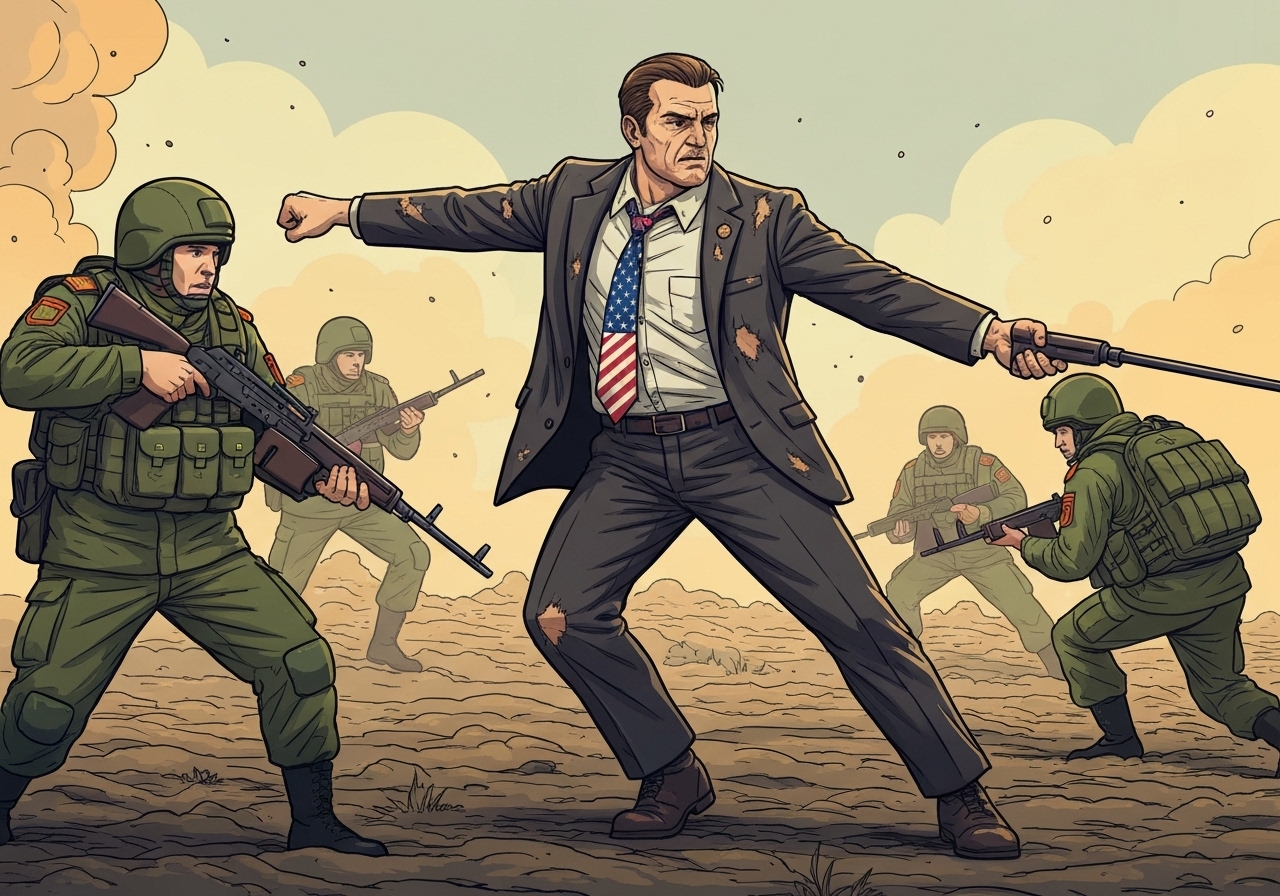
Colonel Andrei Demurenko, 67, was a rare figure who trained in the United States in 1992 at Fort Leavenworth and later returned from retirement to fight for Russia in Ukraine, dying after a mortar strike near Bakhmut in 2023. His life traced a path from classroom exchanges with American officers to front-line patrols in ankle-deep mud, illustrating how individual choices intersect with larger geopolitical narratives. U.S. and NATO officials, and readers of a small Russian military journal, took notice when his war memoir circulated in 2024 and 2025, prompting renewed debate in Washington and Moscow. The episode highlights tensions between person-to-person military exchanges and the polarizing propaganda that has shaped the Russia–Ukraine conflict.
Key Takeaways
- Andrei Demurenko, 67, attended the U.S. Army Command and General Staff College at Fort Leavenworth in 1992 as the first Russian officer selected for that program; his U.S. study is a documented fact.
- Demurenko returned from retirement in 2023 to serve on the front lines in eastern Ukraine and was later killed by a mortar blast near Bakhmut, according to published accounts.
- He told his life-and-war story in a Russian military journal; that piece was circulated and read by staff at the U.S. Embassy in Moscow, the Army’s European headquarters, and the Pentagon.
- Demurenko described a leadership ethos of sharing danger with subordinates, traveling from trench to trench and sleeping in mud to be near vulnerable troops.
- His trajectory—from hopeful exchange student to combatant aligned with Kremlin narratives—illustrates how longstanding personal ties did not prevent radical shifts in belief and action.
Background
In 1992, as the Soviet Union’s dissolution left many questions about post–Cold War order, the U.S. Army invited a small number of foreign officers to Fort Leavenworth for professional education. Demurenko’s selection for that program made him a symbolic bridge between once-adversarial militaries and suggested possibilities for cooperation. For a time, American officers and their Russian counterparts described the moment as one of optimism; some scholars called it part of an era in which broad cooperation seemed possible.
Over the next three decades, however, bilateral relations cooled. Political disputes, NATO expansion, and competing security narratives widened gaps between Washington and Moscow. Russian state media and official statements increasingly framed Ukraine and Western support as existential threats, a line that reached broad domestic audiences. Veterans, retired officers, and active commanders consumed these narratives in different ways; some remained committed to international military exchange, while others embraced the Kremlin’s framing as justification for force.
Main Event
By 2023, Demurenko had left active duty but decided to rejoin military operations in eastern Ukraine. He traveled from a command post to forward positions near Bakhmut, moving through trenches in bad weather to see struggling units in person. He told colleagues and later wrote that he believed leaders should share the hardships their soldiers faced—an ethos he enacted by sleeping in wet trenches and inspecting positions under fire.
Combat around Bakhmut, a city repeatedly contested during the 2022–2023 fighting, was intense; artillery and mortar barrages were common. According to accounts published in a Russian military journal and republished in open reporting, Demurenko was struck by mortar fire during one of these frontline visits and died from his wounds. The published reminiscences and official commentaries circulated widely enough to attract attention in Washington, where analysts and diplomats flagged the story.
U.S. military readers and embassy personnel obtained and discussed the journal piece in 2024 and 2025, sharing it internally among the Army’s European command and at the Pentagon. For American colleagues who had met him at Fort Leavenworth three decades earlier, the image of a once-friend returning to fight for the other side prompted a mix of sorrow and professional puzzlement. The narrative has been interpreted variously as a personal tragedy, a cautionary tale about propaganda, and evidence of the deep social reach of wartime messaging inside Russia.
Analysis & Implications
Demurenko’s story underscores how individual biography can cut across institutional exchange programs. Professional military education aims to build shared doctrine, mutual understanding and professional norms, but those outcomes are not assured nor permanent. The presence of a U.S.-trained Russian officer among frontline casualties illustrates that training exchanges do not immunize participants against later political radicalization or shifts in allegiance.
At a policy level, the episode complicates assessment of military-to-military ties. U.S. training programs are often justified on grounds of transparency and stability; yet participants return to very different domestic contexts where state narratives and incentives can reshape outlooks. For Washington, the case invites a reexamination of how alumni networks are tracked and how long-term influence is measured.
For Moscow, the publicizing of Demurenko’s motives and conduct served domestic political functions, portraying him as a loyal veteran answering a call to defend the nation. Internationally, his death became another data point in debates about the durability of professional ties and the influence of information ecosystems that amplify nationalist narratives and disinformation.
Comparison & Data
| Year | Event |
|---|---|
| 1992 | Demurenko attends U.S. Army Command and General Staff College, Fort Leavenworth |
| 2023 | Returns from retirement to fight in eastern Ukraine; killed near Bakhmut by mortar fire |
| 2024–2025 | Memoir/personal account published in Russian military journal and circulated among U.S. officials |
The simple timeline above frames a three-decade arc from exchange and optimism to frontline death and renewed geopolitical friction. While individual cases do not alone define bilateral policy, aggregated examples like this inform debates about the long-term effects of training exchanges and the resilience of professional ties under strain.
Reactions & Quotes
U.S. military colleagues who recalled Demurenko’s time at Fort Leavenworth described a stark contrast between earlier professional camaraderie and later battlefield realities. The following excerpts capture the responses documented in published accounts and official briefings.
“The end of history,”
Academic commentator quoted in reporting
This phrase, used by a scholar in reference to early post–Cold War optimism, was invoked by several observers to mark how expectations of stable peace after 1991 did not endure.
“A good leader should experience the worst of war alongside his soldiers,”
Col. Andrei Demurenko, as quoted in a Russian military journal
Demurenko’s own words, published in a Russian military outlet, described his personal commitment to share hardship with frontline troops and explain his presence in forward positions despite his age and rank.
“His story forced us to ask hard questions about the limits of people-to-people ties in an era of information warfare,”
U.S. defense analyst (summary of remarks)
Analysts in Washington said the case prompted renewed scrutiny of how narratives and propaganda can reshape individual choices even among those with prior cross-national contacts.
Unconfirmed
- The precise motivations for Demurenko’s decision to return from retirement are debated; published accounts attribute it in part to belief in Kremlin framing, but private motives and context remain partly unclear.
- The degree to which his U.S. training directly influenced his later conduct (either restraining or accelerating it) is not established by available public reporting.
- Reports vary on how widely his journal piece was circulated inside Russian military channels versus foreign diplomatic circles; the full chain of dissemination is not independently verified.
Bottom Line
Colonel Demurenko’s life and death illustrate the limits of institutional exchange as a safeguard against divergent political trajectories. Training programs create networks and shared expertise, but they do not guarantee long-term alignment of views or prevent later choices shaped by domestic politics and information environments.
For policymakers, the case argues for nuanced evaluation: sustain professional ties where they serve transparency and mutual safety, while recognizing that individual alumni may respond differently to future crises. For analysts and the public, the story is a reminder that human biographies often reflect broader geopolitical shifts rather than straightforward cause-and-effect relations.