
Lead
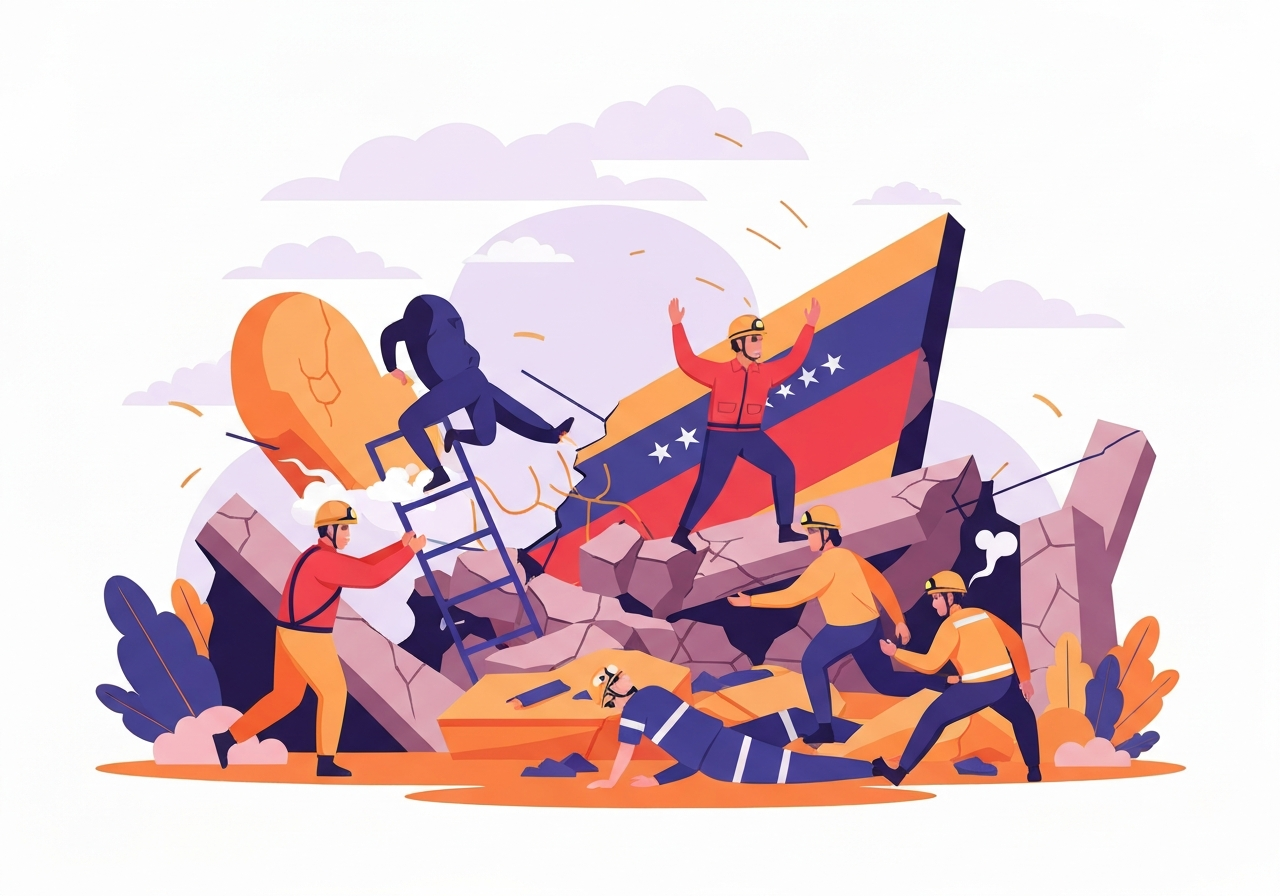
Rescue teams are racing to reach survivors after back-to-back earthquakes struck northern Venezuela on Wednesday, leaving at least 920 people dead and 3,360 injured, officials said. The hardest-hit coastal state of La Guaira has been declared a disaster zone and fully militarized as crews search through collapsed buildings. International rescue teams and emergency supplies are arriving, but locals and health workers report shortages and slow logistics. Authorities warn the first 48–72 hours are critical for finding people alive beneath the rubble.
Key Takeaways
- Confirmed fatalities: National Assembly President Jorge Rodríguez reported at least 920 deaths nationwide, with most in La Guaira.
- Injuries and trapped: Authorities say 3,360 people were injured and at least 172 remain trapped under rubble.
- Infrastructure damage: Officials report 383 affected buildings, 13 damaged hospitals, 25 shopping centers and 1,002 other structures.
- International response: Countries including the United States, Mexico, El Salvador, Colombia, Spain and others have dispatched rescue teams, supplies and equipment.
- Health system strain: Doctors report shortages of water, antibiotics, IV fluids and anesthetics; two hospitals have collapsed in Caracas and La Guaira.
- Local mobilization: Civilian volunteers and clubs are organizing collection points and ad-hoc shelters for displaced families.
- Logistical hurdles: Airport damage and damaged roads are slowing large-scale deliveries of aid and heavy machinery.
Background
Wednesday’s twin earthquakes struck coastal Venezuela, producing the country’s worst seismic toll in decades and triggering hundreds of aftershocks. La Guaira state, a densely populated coastal corridor that includes Caraballeda and Catia La Mar, suffered the heaviest structural damage and the largest share of casualties. Many buildings there are older and were unable to withstand the tremors, compounding the human toll.
The shocks come amid a national context of prolonged economic hardship and political instability that has weakened public services and emergency preparedness. Medical personnel and relief organizations have warned for years about underfunded hospitals and insufficient stockpiles, conditions that complicated the immediate response. Earlier political events this year also altered security dynamics and international relations, affecting how aid channels operate.
Main Event
Search-and-rescue operations intensified as specialist teams from several countries arrived. El Salvadoran rescuers reported locating 15-year-old Camila Sofía Medina Rivas on the ninth floor of a collapsed building in Catia La Mar; crews said they still needed to breach multiple walls to free her. Eyewitnesses and local footage show survivors being extracted in Caraballeda while many neighborhoods remain reduced to piles of rubble.
Venezuelan authorities say La Guaira is under full military control to ensure rescue corridors remain open and to manage access. Officials report using controlled percussion equipment to break concrete and reach voids where survivors might be trapped, but repeated aftershocks and limited heavy machinery are slowing operations in some sectors.
The government has set up stockpiles of food, water and medicines at the Foreign Ministry in Caracas, and announced a centralized volunteer registration at the Poliedro de Caracas. Still, residents in coastal towns and near airports have expressed frustration at delays and the perceived scarcity of personnel and equipment during the critical early window.
Analysis & Implications
The human cost will likely rise as teams continue to comb through unstable structures. In large earthquakes the probability of finding survivors beyond 72 hours falls sharply; with 172 people still listed as trapped, speed of access to heavy lifting equipment will be decisive. Venezuela’s degraded infrastructure—damaged airports and old hospital buildings—complicates both life-saving care and the delivery of bulky rescue gear.
Politically, the disaster intensifies pressure on national and regional authorities already managing economic and governance crises. The need to coordinate multinational assistance may force temporary cooperation between actors who have had strained relations. How the state manages distribution and transparency of incoming aid will shape domestic and international judgments of the response.
Economically, reconstruction will be costly and protracted. Collapsed housing, damaged clinics and disrupted transport networks will require sustained funding and capacity for months or years. International pledges—such as the US-provided assets and other national contributions—can help in the short term, but long-term recovery depends on both financing and the capacity to implement repairs at scale.
Comparison & Data
| Metric | Reported figure |
|---|---|
| Deaths | 920 (national assembly) |
| Injured | 3,360 |
| People trapped | 172 |
| Buildings affected | 383 |
| Hospitals damaged | 13 |
| Shopping centers | 25 |
| Other structures | 1,002 |
These consolidated figures are the latest official counts provided by National Assembly President Jorge Rodríguez. Historical context: Venezuela’s last major seismic events caused far fewer casualties, but comparisons are complicated by different population densities and building stock. The scale of hospital damage is particularly consequential given pre-existing shortages of supplies.
Reactions & Quotes
Venezuelan officials, international agencies and local health workers have all commented on the unfolding crisis. Below are representative remarks with context.
“At least 920 people are dead and over 3,000 injured,”
Jorge Rodríguez, President of the National Assembly (official update)
Rodríguez provided the consolidated death and injury figures and described La Guaira as the epicenter of much of the destruction, urging the public not to travel there so rescue teams can operate.
“We have found Camila Sofía Medina Rivas alive… her mother is waiting for her downstairs with part of our team,”
Nayib Bukele, President of El Salvador (social post)
Bukele’s office described the Salvadoran team’s progress rescuing a teenager trapped on a ninth-floor collapse, emphasizing the role of international urban search-and-rescue units and specialized equipment.
“The Venezuelan healthcare system has declined progressively… we lack the necessary resources to handle day-to-day issues,”
Dr. Huniades Urbina-Medina, pediatrician (medical source via media)
Dr. Urbina-Medina described chronic shortages and the difficulty hospitals face treating a sudden influx of trauma patients, noting that two hospitals had collapsed in the quake-affected zones.
Unconfirmed
- Precise distribution of incoming international supplies to specific hospitals remains unclear and has not been independently verified.
- Reports that every affected hospital has sufficient staff and equipment are unconfirmed; local physicians report shortages and improvisation.
- Some social-media accounts allege exact counts of missing family members; those individual claims are still being compiled and verified by authorities.
Bottom Line
Venezuela faces a large-scale humanitarian emergency with immediate rescue needs and medium-term recovery challenges. The confirmed toll—920 dead and thousands injured—reflects both the intensity of the quakes and vulnerabilities in housing and public services. Rapid arrival and coordinated distribution of heavy machinery, medical supplies and shelter materials will determine how many more lives can be saved and how quickly basic needs are met.
International contributions are already augmenting local efforts, but sustained logistics, transparent management and investment in resilient infrastructure will be required for months. For readers: the situation remains fluid; official numbers and on-the-ground conditions can change as rescue teams continue operations and assessments are updated.
Sources
- CNN — news media (live reporting, casualty and response figures)
- International Rescue Committee (IRC) — NGO (operational commentary on relief logistics)
- Médecins Sans Frontières (MSF) — NGO (medical supply donations reported)
- U.S. Department of State — official (statements on U.S. aid and assets)
- Reuters — news media (international assistance dispatches)