
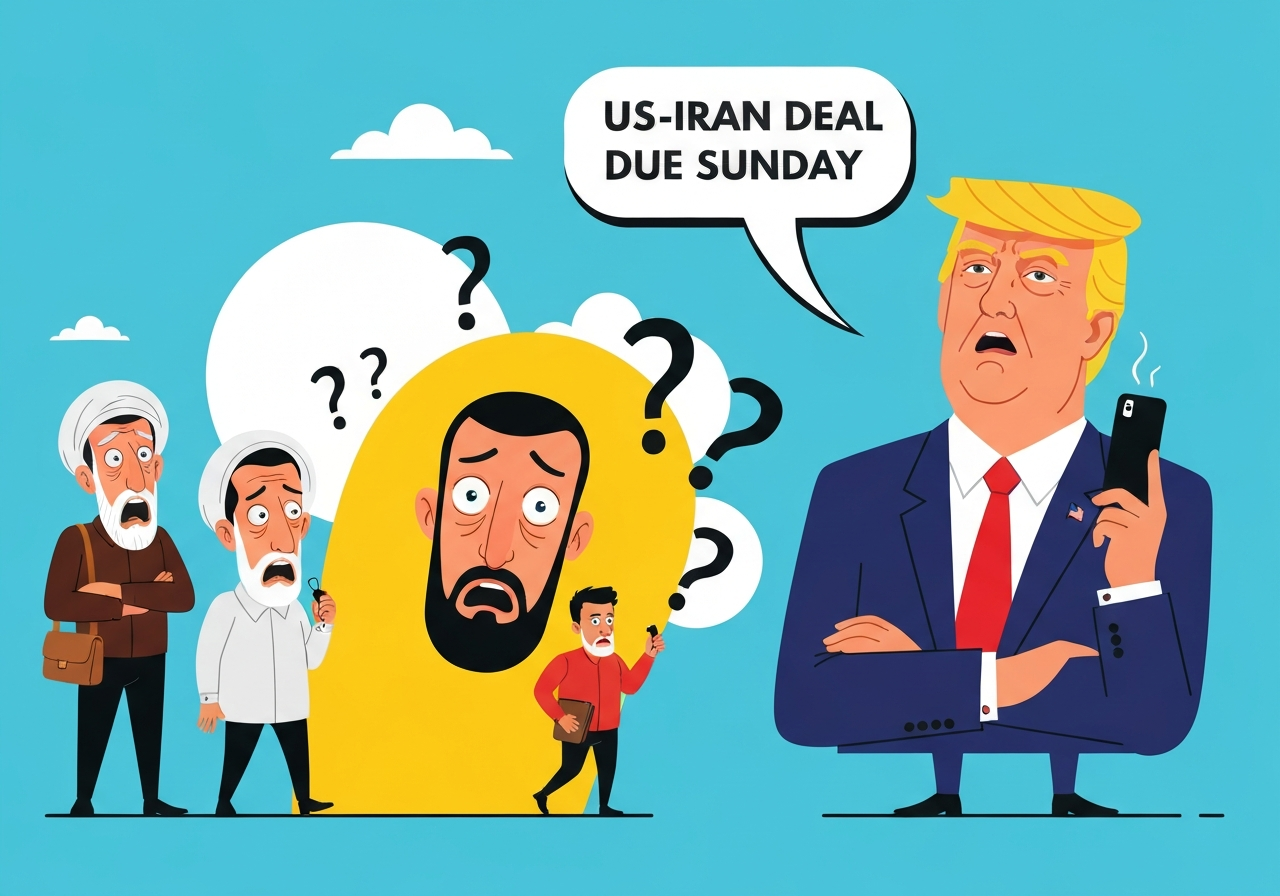
President Donald Trump announced that a memorandum intended to end direct hostilities between the United States and Iran is scheduled to be signed on Sunday, while Tehran signalled the date may slip. Trump wrote on Truth Social that once the agreement is signed the Strait of Hormuz would be “open to all” and indicated U.S. forces could later remove Iran’s enriched uranium stockpiles. Pakistani mediators said electronic signing was being prepared within 24 hours, even as an Iranian foreign ministry spokesman urged caution about the precise timetable.
Key takeaways
- President Trump posted that the US‑Iran memorandum is scheduled to be signed on Sunday and that the Strait of Hormuz would be reopened to all shipping once concluded.
- Pakistan — a broker in the talks — said it expected the deal to be finalised within 24 hours and was preparing for an electronic signing.
- Iranian foreign ministry spokesman Esmail Baghaei warned the exact signing date was uncertain and said it “will not be tomorrow [Sunday],” signalling Tehran’s reservations.
- A Qatari delegation arrived in Tehran on Sunday; Qatari and Pakistani officials have both played mediation roles in the negotiations.
- U.S. officials said any economic benefits for Iran would be conditional on Tehran meeting its obligations, and that nuclear‑related talks would follow security arrangements.
- The current round of conflict began with U.S. and Israeli strikes on Iran on 28 February; despite an April ceasefire, exchanges of fire have continued intermittently.
- Israel is not party to the U.S.‑Iran memorandum and has continued strikes against Hezbollah; 29 villages in southern Lebanon were ordered evacuated on Sunday.
Background
The confrontation intensified after coordinated U.S. and Israeli strikes across Iran on 28 February, which prompted retaliatory attacks by Iran on Israel and U.S. allies in the Gulf and effectively disrupted traffic through the Strait of Hormuz, a critical route for global oil and LNG. Diplomatic channels involving Pakistan and Qatar emerged as mediators, aiming to convert a fragile ceasefire into a broader agreement that addresses both regional security and nuclear concerns.
In April, a ceasefire was declared but it did not end episodic exchanges of fire between U.S. and Iranian forces nor between Israel and Iran‑aligned groups. Western governments have long accused Iran of pursuing uranium enrichment beyond civilian needs; Tehran denies an intent to build nuclear weapons and frames its programme as civilian, for power generation and research.
Main event
On Saturday, Mr. Trump posted on Truth Social that the memorandum would be signed on Sunday and that the Strait of Hormuz would immediately be “OPEN TO ALL.” He added that, “at the appropriate time, when all is calm, we will go in and get the Nuclear Dust,” referring to Iran’s enriched uranium stores and saying the material would later be destroyed. The social post set a public deadline that Tehran has publicly questioned.
Pakistani Prime Minister Shehbaz Sharif told followers on X that Pakistan was “closer to a peace deal than ever before” and that electronic signing preparations were underway within 24 hours. Pakistani officials have been prominent intermediaries, coordinating logistics and timing between Tehran and Washington and relaying technical arrangements.
Iranian foreign ministry spokesman Esmail Baghaei cautioned against assuming a Sunday signature, saying officials must “wait and see” and noting the signing would not be on the next day. Separately, Iran’s foreign minister Seyed Abbas Araghchi said on Friday that a deal was close and that the agreement envisaged an end to conflict between Israel and Hezbollah, with nuclear discussions to follow.
Analysis & implications
If signed, the memorandum would mark a rare direct accord between Washington and Tehran after months of hostilities and could relieve immediate pressure on global energy routes by reopening the Strait of Hormuz to commercial shipping. That would likely calm short‑term volatility in oil and LNG markets and reduce insurance and rerouting costs for shippers using Gulf passages.
However, substantial implementation risks remain. U.S. statements tying economic benefits to Iranian compliance indicate sanctions relief would be phased and reversible, requiring robust verification mechanisms. Tehran’s public hesitation about timing suggests internal political obstacles or demands that could complicate final text and sequencing.
Regionally, Israel is not a signatory and has repeatedly said it will continue operations against Hezbollah in Lebanon, a stance that could undermine any attempt to enshrine a durable Iran‑Israel cessation. Continued Israeli strikes and evacuation orders in southern Lebanon demonstrate how third‑party actors can frustrate a bilateral U.S.‑Iran understanding.
Comparison & data
| Key date | Event |
|---|---|
| 28 February | U.S. and Israeli strikes across Iran — escalation begins |
| April | Ceasefire declared between some parties; intermittent clashes continue |
| Late June (current week) | Brokered memorandum reportedly near signature; mediators prepare for electronic signing |
The timeline highlights repeated near‑agreements that have unraveled in final stages in recent months. Past ruptures show the fragility of negotiations and the role of sequencing — security steps first, then nuclear and economic arrangements — in any sustainable settlement.
Reactions & quotes
U.S. president’s public deadline drew both support and skepticism; Pakistani and Qatari mediators remain active but cautious. Below are representative official lines and their immediate contexts.
The Deal is scheduled to get signed tomorrow, and immediately after it is signed, the Hormuz Strait is OPEN TO ALL.
Donald J. Trump (Truth Social)
Trump framed the announcement as a decisive outcome that would restore maritime security. His post also referenced future U.S. steps regarding Iran’s uranium, signaling a follow‑on phase beyond the memorandum.
We will have to wait and see about the exact date of the signing of the memorandum of understanding, although it will not be tomorrow.
Esmail Baghaei (Iranian foreign ministry spokesman)
Baghaei’s caution underscored Tehran’s reluctance to confirm the precise timetable publicly and suggested internal or diplomatic conditions remained unresolved.
We are closer to a peace deal than ever before; finalisation likely expected in the next 24 hours.
Shehbaz Sharif (Prime Minister of Pakistan)
Sharif’s statement reflected Pakistan’s role as intermediary and its operational preparations for an electronic signing procedure — a practical step that mediators described as necessary if a rapid conclusion were possible.
Unconfirmed
- Whether the memorandum will in fact be signed on Sunday — Tehran has publicly indicated the date may not hold.
- Whether the agreement fully includes a cessation between Israel and Hezbollah — reports differ and Israel is not a party to the U.S.‑Iran memorandum.
- The precise scope and timing of any sanctions relief or economic benefits for Iran remain unspecified until implementing details are published.
Bottom line
The announced Sunday signing, if realised, would be an important step toward de‑escalation and could immediately ease pressure on global shipping routes and energy markets. Yet public signals from Tehran and the pattern of previous near‑agreements counsel caution: the headline commitment is only the start of a complex, verifiable implementation process.
Key risks include Iran’s internal political dynamics, Israel’s exclusion from the deal, and the need for reliable verification mechanisms before economic incentives are delivered. Observers should watch for a published text, timelines for nuclear talks, and any conditionality tied to sanctions relief as the true test of durable progress.
Sources
- BBC News — news report on negotiation status and statements (media)