
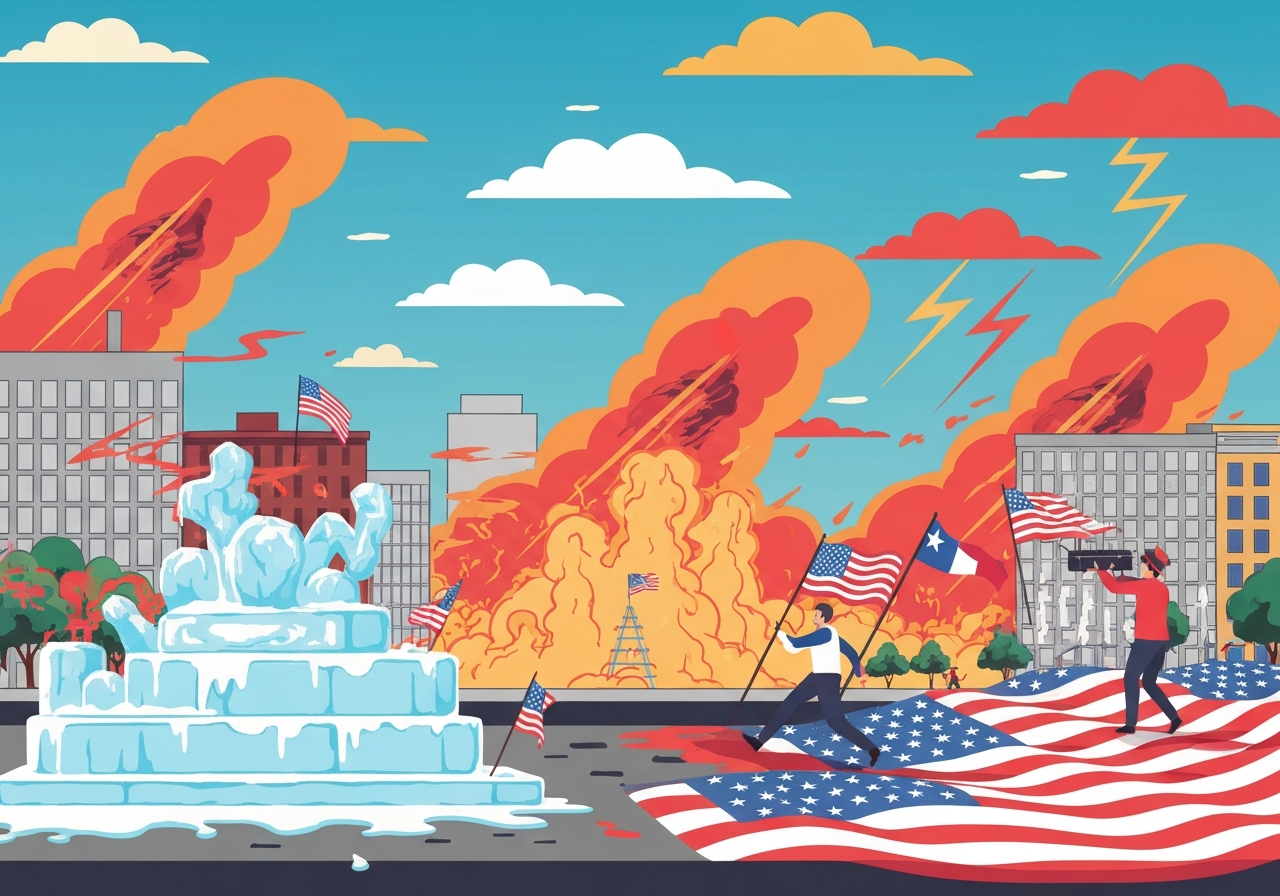
As the United States marked its 250th Independence Day on 4 July 2026, widespread heat and fast-developing storms upended celebrations from Washington DC to New York. Extreme temperatures and high humidity forced event cancellations, left hundreds of thousands without power and prompted emergency weather watches, even as flyovers, fireworks and traditional contests proceeded. In Coney Island, veteran competitive eaters Joey Chestnut and Miki Sudo won their respective Nathan’s Hot Dog Eating Contest divisions, while officials in the capital adjusted plans amid sweltering conditions and a looming severe thunderstorm watch. The day combined ceremonial pageantry with weather-driven disruption, creating a mix of spectacle and logistical strain for organisers and attendees.
Key takeaways
- Official anniversary events took place nationwide on 4 July 2026 as the US observed its 250th birthday with flyovers, fireworks and public ceremonies.
- A heatwave gripped the eastern US: Washington DC reached about 101F (38C) with a feels-like near 104F (40C); parts of Maryland, Delaware and New Jersey were forecast to hit 108F (42C).
- Nearly 750,000 customers lost power across the eastern US during the period, including about 350,000 in Michigan and 150,000 in New Jersey, per outage tracking data.
- Thunderstorms developed west of Washington DC and a severe thunderstorm watch was in place for the capital region until 22:00 local time (03:00 BST), raising risks of lightning, hail and strong winds.
- At Coney Island, Joey Chestnut won his 18th Nathan’s title with 66 hot dogs in 10 minutes; Patrick Bertoletti was second with 51. Miki Sudo claimed her 12th women’s title with 38.75 hot dogs; Michelle Lesco finished second with 22.
- Some local displays were cancelled over fire risk and high winds — Colorado municipalities called off fireworks amid dry conditions and wildfire concerns.
- A time capsule buried in Philadelphia includes an Alaskan diamond, state poems, Nevada gambling chips, New Mexico sand and an AI-generated printout intended for reopening in 2276.
Background
The 250th anniversary—commemorating the signing of the Declaration of Independence in 1776—has been planned for years through a federal commission and numerous local initiatives. The milestone arrives amid heightened political attention and public pageantry, including military flyovers and high-profile presidential participation. Traditionally large gatherings and longstanding rituals — parades, concerts and civic ceremonies — are now occurring in a climate context of more frequent extreme heat and volatile storm patterns across the eastern United States. Emergency-response agencies and local organisers have been coordinating advisories, hydration stations and contingency plans as part of public-safety preparations.
Weather patterns this July combined prolonged heat and abundant humidity, which reduces the body’s ability to cool itself by sweat evaporation and raises the heat index significantly above air temperature. In recent decades, the region has repeatedly seen heat events that strain electrical grids and emergency services, increasing the chance of outages and heat-related illness. Event planners now routinely weigh spectacle against safety: fireworks and large outdoor gatherings are particularly sensitive to the twin threats of heat stress and rapidly evolving convective storms. The 200th anniversary in 1976 similarly featured orchestrated national ceremonies, but with different security and climate contexts.
Main event
In Washington DC, security perimeters and vehicle barriers were visible around the White House and National Mall, where organisers staged the Freedom 250 events and a planned fireworks display. Attendance appeared uneven: despite televised pageantry, wide stretches of pedestrian areas were lightly populated as many residents heeded heat warnings. Officials reported temperatures near 101F (38C) in the capital by midafternoon, with moist air producing a dangerous heat index; volunteers and military personnel distributed water and cooling supplies to attendees.
Storm development late in the day added urgency to the response. Radar showed a cluster of thunderstorms forming west of Washington DC that forecasters expected to move across the city. The National Weather Service issued a severe thunderstorm watch for the capital region until 22:00 local time (03:00 BST), warning of frequent lightning, possible large hail and damaging winds. Some satellite events, including a parade in Annapolis, were cancelled or modified as a direct result.
Meanwhile in New York City, the traditional Nathan’s Famous Hot Dog Eating Contest drew its usual crowd and television audience at Coney Island. Joey Chestnut extended his dominance with an 18th title after consuming 66 hot dogs in 10 minutes, while Miki Sudo secured her 12th women’s crown with 38.75 hot dogs. Elsewhere in the city, the RAF Aerobatic Team, the Red Arrows, flew a smoke-lined formation over Manhattan as part of an international flypast that included more than 150 aircraft.
Power systems across the eastern US experienced significant stress: high demand from air conditioning, combined with severe weather in parts of the region, contributed to outages affecting nearly three-quarters of a million customers. In Michigan, utility company DTE reported storm-related damage including winds above 60mph (97km/h) as a cause of many outages. Utilities and emergency services staged repairs and shared public-safety advisories through the evening.
Analysis & implications
The convergence of a major national milestone and an extreme-heat event highlights the planning challenges governments and organisers face when delivering large-scale public ceremonies. Heatwaves elevate health risks—heat exhaustion, heatstroke and exacerbation of chronic conditions—especially among vulnerable populations such as the elderly and outdoor workers. When combined with power outages, those risks multiply: cooling centers and electrically powered medical devices can be compromised, and communications may be disrupted during critical hours.
From an infrastructure perspective, the outages underscore grid vulnerability to simultaneous high demand and storm-related damage. Utilities have increasingly adopted resilience measures—tree trimming, grid hardening, targeted smart-grid investments—but episodic failures remain likely as weather extremes intensify. The scale of outages reported on 4 July will prompt reviews of restoration priorities, mutual-aid agreements among utilities and potential acceleration of investments in distributed energy and backup cooling options.
Politically and socially, the holiday’s high-profile events put leaders on display. Presidential remarks and large public spectacles can shape narratives about competence and national unity, even as weather conditions force trade-offs between celebration and safety. For public trust, transparent communication about cancellations, delays and risks matters as much as the pageantry itself. The prominence of private, parallel events—such as the Trump-backed Freedom 250 activities—also highlights how public commemoration can be fragmented among competing organisers and messages.
Comparison & data
| Item | Value / Note |
|---|---|
| Washington DC peak air temp | ~101F (38C); feels like ~104F (40C) |
| Baltimore peak | 104F (40C) |
| Highest forecast (MD/DE/NJ) | Up to 108F (42C) |
| Power outages (approx.) | ~750,000 customers affected (350,000 MI; 150,000 NJ) |
| Chestnut (Nathan’s) | 66 hot dogs — 18th title |
| Sudo (women’s) | 38.75 hot dogs — 12th title |
These figures illustrate the intersection of meteorological extremes and social events: multi-degree heat-index increases translate into markedly higher health risk, while outage counts reflect both storm impact and grid loading. Planners will review these data to refine thresholds for event cancellation or modification and to prioritise investments in grid resilience and community cooling infrastructure.
Reactions & quotes
“There is something profoundly humbling about this task,” said America 250’s executive vice president after the time capsule ceremony, framing the dedication as an exercise in stewardship for future generations.
Jennifer Condon / America 250 (official)
Wing Commander Jon Bond of the RAF’s Red Arrows described the New York flypast as “a huge honour,” noting the display underscored the longstanding ties between the United Kingdom and the United States.
Wing Cdr Jon Bond / RAF (military spokesperson)
On social media, former President Donald Trump wrote that “crowds in DC are incredible” despite the heat, while also praising the aerial demonstrations and the appearance of the National Mall.
Donald Trump / Truth Social (public statement)
Unconfirmed
- Reported claims that portions of the Reflecting Pool were vandalised ahead of the event remain unverified by independent confirmation at the time of publication.
- Initial local reports suggested the World Cup match between Paraguay and France might be affected by storms; the extent of any disruption to that broadcast or match operations was not independently confirmed.
- Details about every item inside the America 250 time capsule beyond the public list have not been exhaustively validated by an independent inventory.
Bottom line
The US 250th anniversary showcased traditional civic rites, high-profile aerial displays and personal milestones such as naturalisation ceremonies and competitive events, but those rituals occurred against a backdrop of significant weather stress. Heat extremes and the threat of severe storms forced adjustments to planned festivities and exposed continuing vulnerabilities in grid resilience and event safety planning. Municipalities and organisers are likely to treat this episode as a case study for better integrating weather risk into the logistics of national-scale commemorations.
For citizens, the practical takeaway is immediate: when attending outdoor events in hot, humid conditions, prioritise hydration, shade and awareness of changing weather alerts. For officials and infrastructure operators, the incident underscores the need for clearer trigger points for cancellations, stronger communications during power outages and faster restoration tactics to protect public health during future high-attendance events.
Sources
- BBC News — live coverage of America 250 and July 4 events (news live)
- PowerOutage.us (utility outage tracker)