
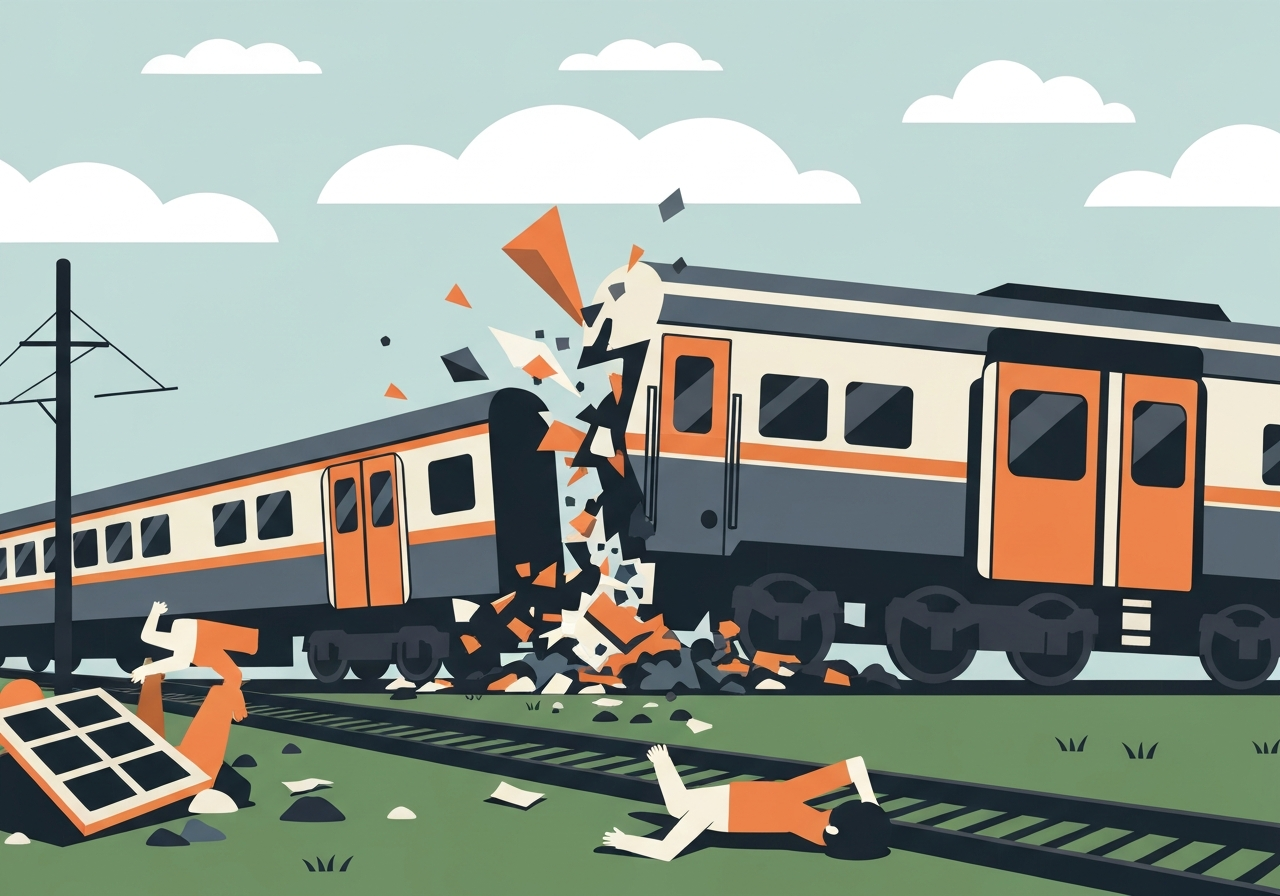
Lead: Two East Midlands Railway passenger trains collided just south of Elstow, near Bedford, shortly after 17:00 BST on Friday, leaving at least one person dead and dozens injured. Emergency services declared a major incident and the East of England Ambulance Service reported 89 people hurt, including 11 with very serious injuries. British Transport Police and local partners are managing the scene while the Rail Accident Investigation Branch (RAIB) has deployed inspectors. Lines between Luton and Bedford were blocked and services to London St Pancras were suspended.
Key takeaways
- Collision time and place: Incident occurred shortly after 17:00 BST, just south of the Elstow interchange between the A421 and A6 near Bedford.
- Casualties: Emergency services reported 89 injured—11 with very serious injuries, 22 seriously injured and 56 with minor injuries—and one confirmed fatality.
- Services involved: Two East Midlands Railway services—the 16:40 Corby to London St Pancras and the 15:50 Nottingham to London St Pancras—were involved in the collision.
- Response: A major incident was declared; Bedfordshire Police, British Transport Police, fire and ambulance crews including air ambulance and Hazardous Area Response Team attended.
- Investigation: The Rail Accident Investigation Branch has sent a team to gather evidence at the scene to establish cause and sequence of events.
- Local impacts: Lines between Luton and Bedford were blocked from about 17:30 BST and hospitals near the scene asked the public to avoid emergency departments unless necessary.
Background
The route south of Elstow is a busy corridor on services linking the East Midlands with London St Pancras. East Midlands Railway operates frequent passenger services along this corridor, including intercity and commuter trains that share track between Luton and Bedford. Rail safety in Britain is overseen by a combination of operator procedures, Network Rail signalling infrastructure and independent accident investigation by the RAIB.
Major-incident responses to collisions typically involve coordinated work by British Transport Police, local police forces, ambulance and fire services; RAIB inspectors then conduct a systematic evidence-gathering process. Trade unions such as the RMT and ASLEF have historically been vocal after serious incidents, pressing for transparency on causes and for improved protections for staff and passengers. Recent years have seen investment in signalling upgrades on some regional lines, but infrastructure and operational pressures remain relevant context for any collision inquiry.
Main event
According to witness accounts and operator statements, the collision took place shortly after 17:00 BST. Passengers described a sudden jolt and reported being thrown from seats; some saw the train ahead of them before impact. Aerial footage shows both EMR trains damaged on the track, with at least one carriage partially deflected off the rails.
British Transport Police initially attended after reports of a collision near Bedford and later confirmed a death at the scene shortly before 21:00 BST. The East of England Ambulance Service said it had treated and transported patients with a range of injuries, deploying air ambulance assets and specialist hazardous-area teams. Bedfordshire Fire and Rescue and local hospitals coordinated to receive casualties and to manage the immediate humanitarian response.
East Midlands Railway confirmed the services involved as the 16:40 Corby–St Pancras and the 15:50 Nottingham–St Pancras and said it was assisting emergency services and Network Rail on site. Rail services to and from London St Pancras were suspended for the remainder of the day as recovery and investigation work continued. The RAIB arrived on site to begin evidence collection, which will include onboard systems, signalling data and witness statements.
Analysis & implications
At this stage investigators will examine multiple hypotheses: a rear-end impact where a following train strikes a stationary or slow-moving unit, a signalling or communications malfunction, or a human factors event such as driver awareness or operational error. Each of these leads requires distinct evidence streams—ATC/ETCS and signalling logs, event recorder (black box) data, CCTV, and witness accounts—to confirm sequence and responsibility.
If the collision proves to be a rear-end impact at speed, questions will arise about the margins of risk on mixed-traffic sections and the effectiveness of existing train protection systems. Conversely, if a signalling or equipment fault is identified, that would focus attention on maintenance regimes, recent works on the line and any outstanding safety recommendations from earlier RAIB reports. Either outcome could prompt immediate operational restrictions and a review of procedures on the route.
The human cost—one confirmed death and dozens injured—will intensify scrutiny on industry safety culture and emergency preparedness. Regulators and unions are likely to press for rapid, transparent disclosure of preliminary findings; operators and Network Rail must balance the need for quick answers with the RAIB’s methodical evidence-gathering. Service disruption will also have economic and social ripple effects for commuters and freight connections in the region over the coming days.
Comparison & data
| Metric | Count |
|---|---|
| Total injured | 89 |
| Very serious injuries | 11 |
| Serious injuries | 22 |
| Minor injuries | 56 |
| Fatalities | 1 (confirmed) |
| Services involved | 2 (16:40 Corby–St Pancras; 15:50 Nottingham–St Pancras) |
This incident’s casualty numbers are significant for a UK inter-city collision in recent years and will be a focal point for comparisons with historical accidents. The immediate data make clear the scale of the emergency response and will form the baseline for both operational disruption reports and future safety recommendations. RAIB’s formal investigation will place these figures alongside technical logs and physical evidence to reach conclusions about cause and mitigation.
Reactions & quotes
Political leaders and union officials responded quickly to the incident, offering condolences and urging thorough investigation. Prime Minister Sir Keir Starmer acknowledged the gravity of the collision and praised first responders.
“My thoughts are with the family of the person who has sadly lost their life, and with those who have been seriously injured.”
Sir Keir Starmer (Prime Minister)
The RMT union confirmed that one of the people who died was a train driver and expressed condolences to colleagues. The union also highlighted reports of multiple serious injuries among passengers and staff.
“We are devastated to learn that a train driver and former RMT rep has tragically died as a result of today’s crash.”
Eddie Dempsey (RMT general secretary)
Emergency services urged the public to avoid the area and to use 999 only for life‑threatening emergencies; nearby hospitals asked people not to attend emergency departments unless absolutely necessary to keep capacity for casualties.
“We have sent a number of resources, including air ambulance and our Hazardous Area Response Team, to a major incident on the railway south of Bedford.”
East of England Ambulance Service (official statement)
Unconfirmed
- Whether the struck train was stationary or moving slowly at the moment of impact is not yet confirmed and remains under investigation by RAIB.
- No official ruling has been published about the role, if any, of signalling faults or driver error; those remain hypotheses pending technical data.
- The identity of the person confirmed dead beyond being a train driver reported by the union has not been publicly disclosed by police for next-of-kin reasons.
Bottom line
The collision south of Elstow is a major rail incident with significant human impact and operational consequences. With 89 injured and one confirmed fatality, the immediate priority has been casualty care and scene preservation for investigators.
RAIB’s on-site evidence gathering over the coming days will be essential to determine cause—whether equipment failure, procedural lapse, or a combination—and to shape safety recommendations. Authorities, operators and unions will face pressure for timely, transparent updates while supporting victims and restoring confidence on the route.