
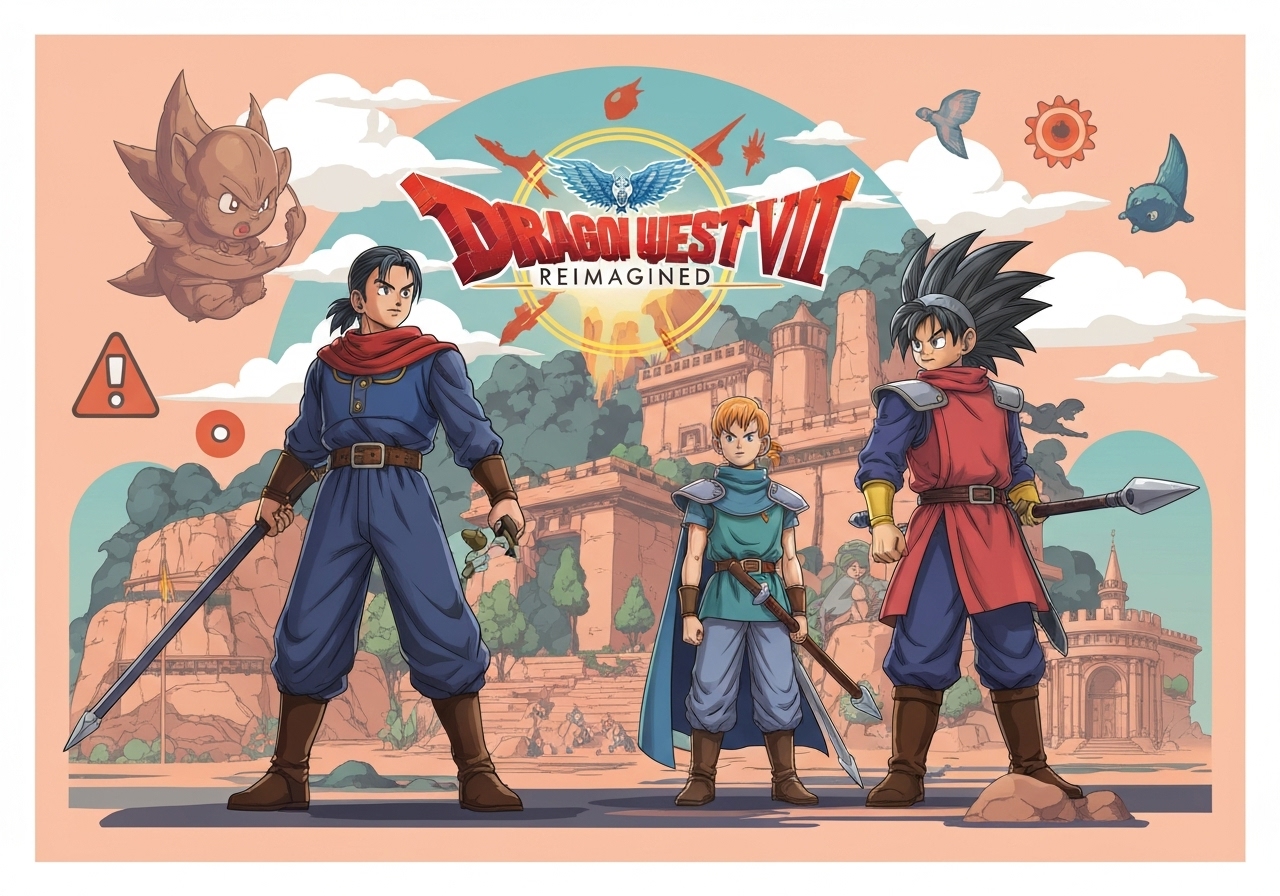
Lead: Square Enix’s Dragon Quest VII: Reimagined, a ground-up remake of the 2000 PlayStation title, is being reshaped to emphasize the original’s grand scope while smoothing its more cumbersome stretches. In hands-on sessions ahead of its February 5, 2026 release, the remake demonstrated a new 3D diorama-inspired art style, a dual-class combat mechanic, and tighter story pacing across multiple early-game scenarios. The team says some subplots were removed and new scenes added to improve flow; the goal is a more focused experience for both returning fans and newcomers on PC, PS5, Xbox Series X|S and Nintendo Switch. Early impressions show the remake preserves the game’s challenge while offering clearer direction and modern conveniences.
Key Takeaways
- The remake launches on February 5, 2026 for PC, PlayStation 5, Xbox Series X|S and Nintendo Switch 1 & 2, preserving a wide platform rollout.
- Visuals have been reworked into expressive 3D diorama-style models inspired by Akira Toriyama’s character art, aiming for a cinematic, animated-adventure feel.
- Combat remains turn-based, but the new Moonlighting system lets characters equip two vocations simultaneously, reducing class-switch grind and increasing tactical options.
- Developers say they cut minor subplots and introduced new scenarios to streamline story progression and strengthen narrative focus, per producer Takeshi Ichikawa.
- Hands-on sections included Emberdale and Wetlock scenarios; both kept the franchise’s dungeon-crawl DNA while offering clearer objectives and fair but potentially punishing boss fights.
- Early gameplay retains the original’s challenge—elite enemies and quest bosses still demand careful resource and skill management despite quality-of-life changes.
- The remake builds on the 2013 3DS update, but aims for a distinct identity through art direction and structural revisions rather than a simple port.
Background
When Dragon Quest VII originally debuted on PlayStation in 2000 it stood out for its vast scale and time-traveling narrative, asking players to recover lost epochs by visiting past eras and restoring history. That structure made it one of the longest, most ambitious entries in the franchise, but also one many players describe as occasionally meandering and grind-heavy. Square Enix later reworked the game for the Nintendo 3DS in 2013, addressing some pacing and interface issues while keeping the core design intact.
Across the series, Dragon Quest has balanced classic turn-based mechanics with a whimsical tone driven by Akira Toriyama’s character designs. Reimagined positions itself as a modern reinterpretation: not merely a visual overhaul but a rethinking of where to tighten the script and where to expand. Key stakeholders include the remake team at Square Enix, long-time franchise director input, and producers such as Takeshi Ichikawa who have framed the project as both respectful to the original and accessible to new players.
Main Event
During preview sessions the remake presented two discrete segments: the Emberdale dungeon—centered on a volcanic ritual to contain a fire demon—and the Wetlock chapter, where townspeople are spirited away to a flooded tower by a mysterious caster. Both sequences preserved the original story beats but felt more guided, with clearer goals and localized narrative hooks that reduce aimless backtracking. Dungeon layouts and enemy placements maintained a legacy of tactical exploration while leveraging the new camera and 3D models to emphasize spatial clarity.
Combat remains classic turn-based but received visible polish. Animations and impact frames make hits and spells read more decisively, while enemy telegraphs and stagger windows give players clearer feedback on tactical choices. The Moonlighting dual-vocation system is the most conspicuous mechanical change: by allowing two concurrent vocations per character, the remake reduces repetitive levelling and unlocks hybrid builds that expand party roles without the old-level-reset penalty.
Difficulty in preview segments stayed faithful to the original’s intent: ordinary encounters were manageable and occasionally lucrative for experience, while elites and quest bosses could rapidly spike challenge. The author found reliable leveling spots in Wetlock against golems and intermittent Metal Slimes, but also encountered fights that required deliberate use of buffs, debuffs and resource juggling to survive. These tests suggest the remake preserves the series’ sense of accomplishment when strategic play is rewarded.
Analysis & Implications
Reimagined’s visual overhaul has implications beyond aesthetics: the diorama-inspired 3D makes exploration easier to parse and enhances emotional expression in NPCs, which supports the team’s stated aim of stronger narrative focus. By shifting presentation, the remake reduces cognitive friction for players who found the original’s menus and 3D transitions jarring. That accessibility is likely to broaden appeal among newcomers while preserving the franchise’s tone for veterans.
Mechanically, Moonlighting tackles a longstanding user-experience problem—class-switching resets—without removing the vocation system that underpins Dragon Quest’s customization. The net effect should lower grind time and allow players to experiment with hybrid builds, which could shorten the effective time-to-fun and reduce barrier-to-entry for less grind-tolerant audiences. For longtime fans, this adds new strategic depth rather than replacing established mechanics.
On the business side, the multi-platform release across PC, current consoles and Switch suggests Square Enix expects both nostalgic sales and a meaningful new-player cohort. If the remake’s streamlining successfully reduces friction while keeping key difficulties intact, it may serve as a template for future remakes of larger, more unwieldy JRPGs. However, community reactions will hinge on how substantive the removed subplots are perceived to be versus the value of the new scenarios.
Comparison & Data
| Version | Year | Platforms | Notable Changes |
|---|---|---|---|
| Original | 2000 | PlayStation | First 3D entry; long time-travel structure |
| 3DS Remake | 2013 | Nintendo 3DS | Pacing and UI adjustments |
| Reimagined | 2026 | PC, PS5, Xbox Series X|S, Switch 1 & 2 | New 3D diorama art, Moonlighting dual-vocation, streamlined story |
The table above situates Reimagined among past editions. While the original established scope and the 3DS version addressed many accessibility points, this remake emphasizes presentation and structural edits intended to modernize pacing and reduce busywork without flattening difficulty.
Reactions & Quotes
“The ‘reimagined’ elements of the narrative allude to improvements in the game’s overall framework, which offers a much deeper and more compelling experience.”
Takeshi Ichikawa, Square Enix (producer)
Ichikawa framed cuts and additions as deliberate trade-offs to tighten the main scenario and introduce fresh content; the preview indicated that some secondary quests were removed while new scenes were integrated to better serve pacing.
“We believe that existing fans will find the game satisfying. At the same time… we’re also excited for many new players to enjoy it as their first Dragon Quest experience.”
Takeshi Ichikawa, Square Enix (producer)
This statement summarizes the project’s dual aim: retain the series’ hallmark depth for returning players while lowering the barrier to entry through quality-of-life and clarity improvements.
Unconfirmed
- The exact list and scope of removed subplots and the full content of newly added scenarios have not been fully disclosed by Square Enix.
- Performance profiles and PC system requirements for the February 5, 2026 release remain to be confirmed ahead of launch and may affect visual fidelity on some platforms.
- The final balance of endgame elite encounters and post-launch content plans (DLC, patches) have not been publicly detailed.
Bottom Line
Dragon Quest VII: Reimagined aims to respect the original’s ambition while addressing the friction that made revisiting the 2000 classic challenging for some players. Early hands-on impressions show a game that retains the franchise’s tactical, turn-based combat and sweeping time-travel story, but wraps them in a more expressive visual language and fewer mechanical annoyances. Moonlighting stands out as a quality-of-life change that also deepens tactical variety, and the diorama-inspired presentation helps the game read like a living animated adventure.
For longtime fans, the remake’s success will depend on whether the cuts to side material feel prudent rather than punitive; for newcomers, the combination of clearer pacing and a modern visual identity may make DQVII the series’ most approachable large-scale entry to date. With a Feb. 5, 2026 release across PC, PS5, Xbox Series X|S and Nintendo Switch, Square Enix is positioning Reimagined as both a faithful revival and a potential blueprint for how major JRPGs are updated for modern audiences.