
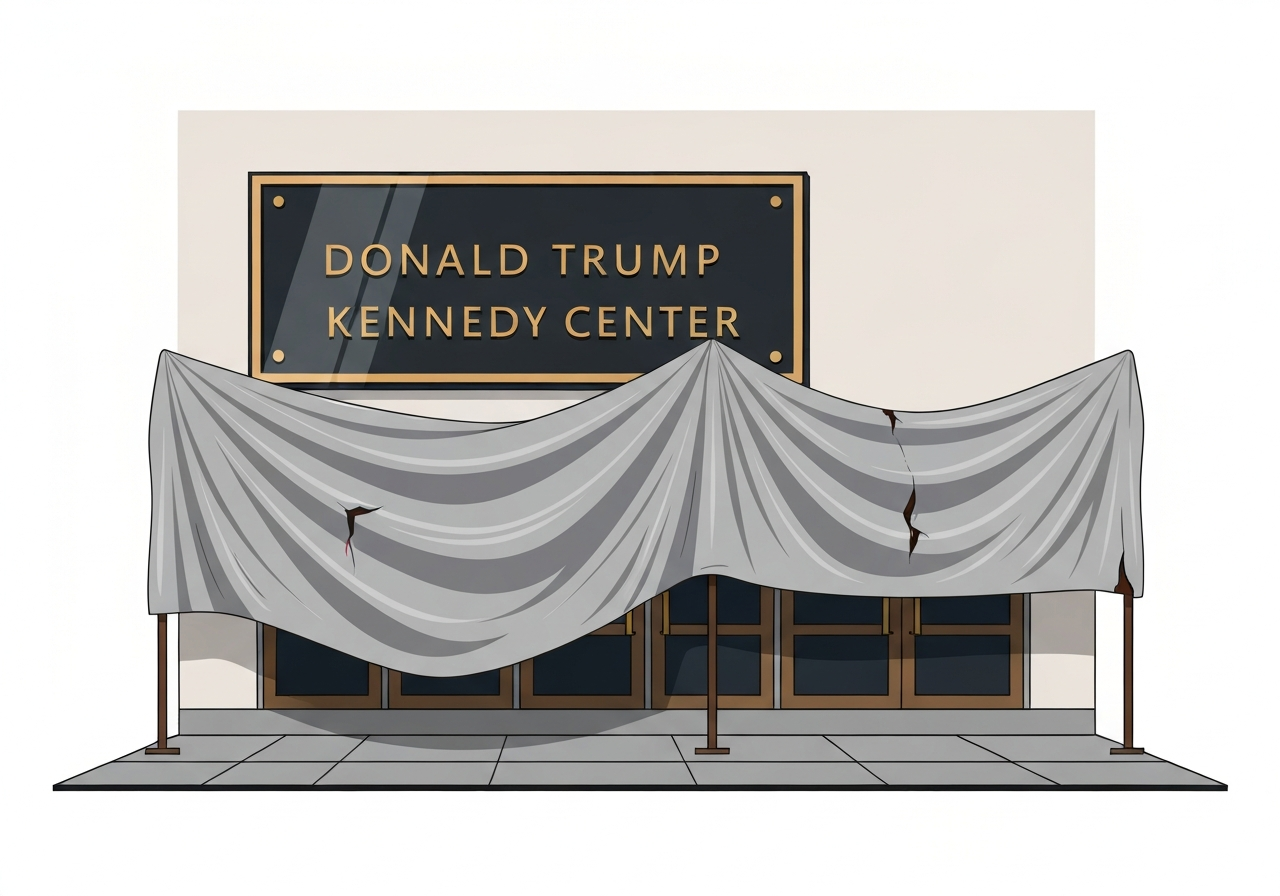
Lead: On June 13, 2026, the Trump administration filed a notice of compliance saying President Trump’s name has been removed from the John F. Kennedy Center for the Performing Arts in Washington, D.C. The filing and a separate statement from Kennedy Center leadership say signage, website references and official documents no longer display the president’s name, though a tarp covering the former lettering remains in place. The change follows a federal judge’s order requiring removal by June 12 and a series of last-minute emergency appeals that were denied. Photos and court records show the center complied while litigation over the name and planned renovations proceeds.
Key Takeaways
- The administration filed a notice of compliance around 11:00 a.m. EDT on June 13, 2026, stating signage and trademark applications tied to the ‘Trump’ name were removed.
- U.S. District Judge Christopher Cooper ordered the name removed and set a deadline of June 12, 2026; an extension to noon on June 13 was granted after the center cited weather delays.
- Kennedy Center president Matt Floca confirmed the name was removed from all physical signage, the center’s website and institutional documents, including email signatures and letterhead.
- An appellate panel declined an immediate stay of Cooper’s injunction and instead asked the parties to file briefs later in June; the panel’s one-page order showed no noted dissents.
- The center’s board voted in December 2025 to add the president’s name and rebrand as the ‘Trump-Kennedy Center’; Judge Cooper ruled in May 2026 that only Congress can authorize such a name change.
- The court also blocked the administration’s plan to close the center for approximately two years for major renovations as part of the same rulings.
- The Justice Department argued an immediate removal could cause donor confusion and fundraising harm, saying some gifts were tied to the presence of Mr. Trump’s name.
- Photos from June 13 show scaffolding and a tarp over the former lettering; the duration of the tarp and timing of any restoration remain unclear.
Background
The John F. Kennedy Center for the Performing Arts was established by Congress as a living memorial to President Kennedy and functions as the nation’s flagship performing-arts institution in Washington, D.C. Historically, changes to the name of a federally created memorial or institution have required congressional authorization, a legal principle central to the challenge brought by Representative Joyce Beatty and others.
In December 2025, the Kennedy Center’s board voted to add President Trump’s name and to rebrand the institution; critics noted the vote came after the administration replaced several Democratic-appointed trustees with allies. The board’s action and the proposed nearly two-year renovation plan prompted immediate opposition, including Beatty’s lawsuit asserting the board lacked authority to rename a congressional memorial.
In May 2026, U.S. District Judge Christopher Cooper agreed that only Congress may authorize a formal renaming and issued an injunction that also stopped the planned prolonged closure for renovations. That ruling set the timetable that led to the June compliance filings and the emergency appeals described below.
Main Event
On the morning of June 13, 2026, attorneys for the administration filed a notice stating they had removed signage ‘that purports to name the Kennedy Center after President Trump,’ updated the center’s website, and withdrawn related trademark applications. Separately, Matt Floca, president and executive director of the Kennedy Center, filed a statement confirming the removal from all physical signage and institutional materials, including employee email signatures and brochures.
Photos published with news coverage show a tarp covering the segment of the facade where the president’s letters had been attached, as well as partial remaining title letters. The filings and images indicate workers erected scaffolding and removed individual letters overnight and early on June 13; the filings also note weather delayed work late on June 12, prompting a brief extension to noon on June 13.
The Justice Department had asked the U.S. Court of Appeals for the D.C. Circuit to stay Judge Cooper’s order and allow the signage to remain during appeal, arguing repeated name changes would cause public confusion and imperil fundraising tied to the name. An appellate panel rejected that emergency stay request in a one-page unsigned order, directing the parties to submit briefs later in June rather than granting an immediate reprieve.
Rep. Joyce Beatty’s legal team urged the appeals court to deny the government’s emergency motion, labeling it a last-minute attempt to avoid compliance and calling the request frivolous. Beatty’s lawyers argued the administration is unlikely to prevail on the merits and said that, if an eventual stay were granted, the name could be restored during an appeal.
Analysis & Implications
Legally, the case underscores a clear separation between congressional authority and executive action over federally created memorials. Judge Cooper’s finding that only Congress can authorize a rename reaffirms precedent that statutory or legislative commissions—not unilateral executive or board action—control official federal memorial titles. That precedent will shape how federal institutions consider donations tied to naming rights and the limits of trustee discretion.
Politically, the episode highlights the potential for presidential influence to reshape cultural institutions through board appointments and branding. Replacing board members with aligned trustees accelerated the rebranding effort, but the courts have constrained that path by reverting important decisions to Congress and judicial review. The dispute may deepen partisan debate over the governance of national cultural institutions and fuel broader legislative proposals to clarify naming authorities.
Economically, the administration’s claim that removing the name would halt fundraising raises complex contract and donor-relations questions. If donors gave conditional gifts tied explicitly to the ‘Trump’ name, the center could face refund obligations or renegotiations; however, those claims require documentation and legal scrutiny. Courts will weigh the asserted fundraising harms against the statutory limits on renaming federal memorials and the equities of complying with injunctions.
Practically, the injunction blocking a two-year closure for renovations leaves the center’s physical condition and maintenance needs unresolved. If the administration pursues alternative renovation plans that avoid a long closure, the timeline, cost estimates and fundraising strategy could shift substantially. An appeal could extend litigation for months, leaving institutional planning uncertain and potentially affecting scheduled performances and contracted artists.
Comparison & Data
| Date | Action |
|---|---|
| December 2025 | Board votes to add president’s name, rebranding as ‘Trump-Kennedy Center’ |
| May 2026 | Judge Cooper rules only Congress can rename the center; injunction issued |
| June 12, 2026 | Original removal deadline set by the district court |
| Early June 13, 2026 | Center cites storms; court extends deadline to noon EDT |
| June 13, 2026, ~11:00 a.m. EDT | Notice of compliance filed; signage and website updated; tarp visible |
The timeline shows a compressed sequence of board action, litigation, and compliance over roughly six months. The table clarifies milestones that led to the physical removal and highlights how emergency filings and short extensions influenced execution on the ground.
Reactions & Quotes
Supporters of the court’s decision argued the judiciary was enforcing statutory limits and preserving congressional authority; opponents said the removal disrupts operations and donor relations. Below are representative statements from the filings and legal teams with brief context.
It does not make sense to alter the Center’s name and signage now, only to potentially revert the name again after what should be a successful appeal.
U.S. Justice Department (emergency motion)
Context: The Justice Department pressed the appeals court for a stay, citing donor confusion and fundraising impacts if signage were removed and later restored.
This is a frivolous stay request, filed at the eleventh hour, in a transparent effort to jam the Court and game the judicial system.
Attorneys for Rep. Joyce Beatty
Context: Beatty’s lawyers asked the appellate court to reject the emergency motion and argued the government had delayed seeking relief until the deadline loomed.
All physical signage, website references and institutional documents have been updated to remove the former name.
Matt Floca, Kennedy Center (filing)
Context: The Kennedy Center’s president submitted a compliance statement to the district court confirming the practical steps taken to follow the injunction.
Unconfirmed
- How long the tarp will remain over the former lettering is not publicly confirmed; scheduling and weather could affect removal or replacement timing.
- The precise dollar value of any donor commitments that might be withdrawn or refunded has not been documented in publicly filed court documents.
Bottom Line
The Kennedy Center has complied with Judge Cooper’s order by removing President Trump’s name from signage, website content and institutional materials as of June 13, 2026, while litigation over the legality of the renaming continues. The appellate process remains open, and the D.C. Circuit’s forthcoming briefs and decisions will determine whether the removal is temporary or permanent.
Beyond this case, the episode highlights tensions over governance of national cultural institutions, the limits of trustee authority versus congressional prerogative, and the practical consequences for fundraising and operations when politically charged naming decisions collide with legal constraints. Observers should watch the appellate timetable and any further filings for indications of how quickly the name might be restored or definitively removed.
Sources
- CBS News (news report)
- John F. Kennedy Center for the Performing Arts (official website)