
Lead
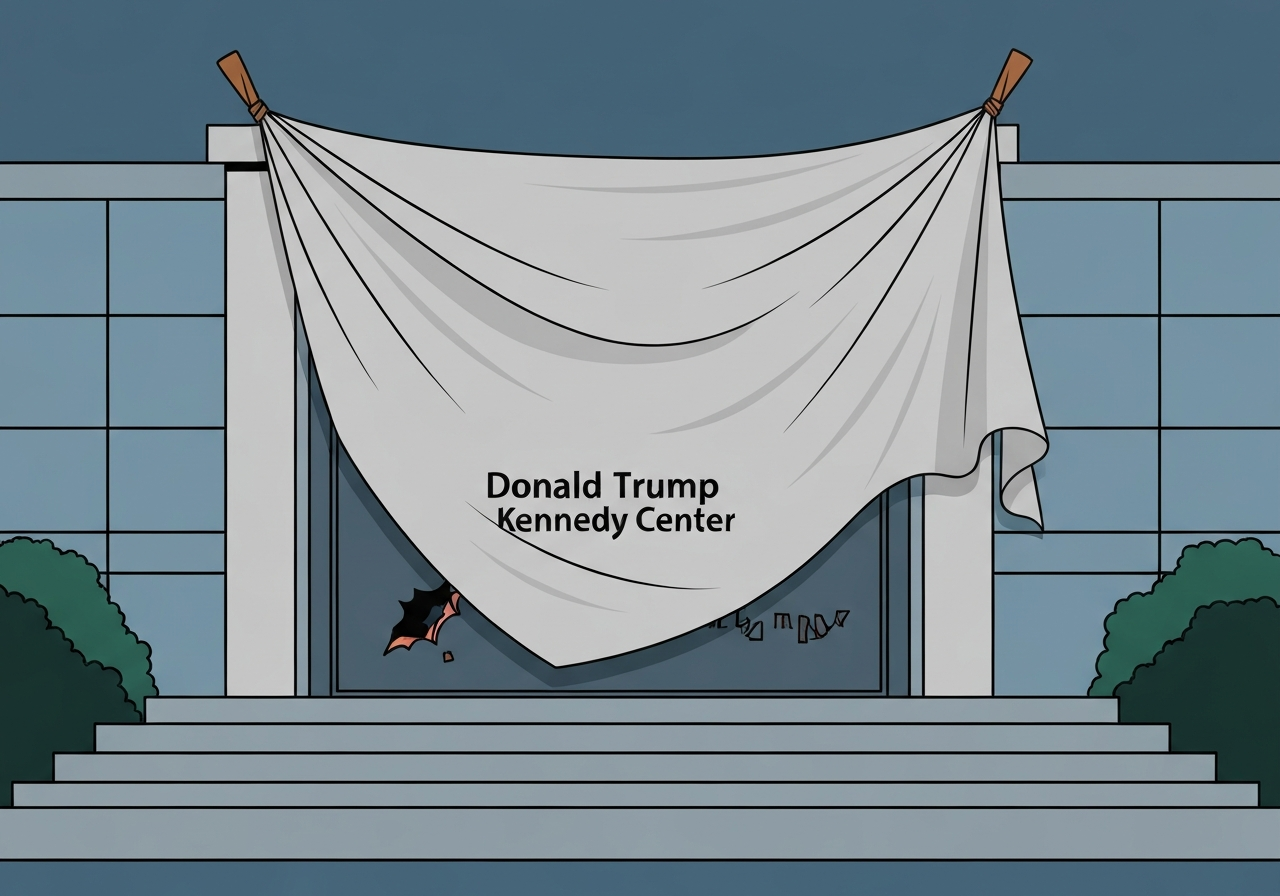
On June 13, 2026, the Trump administration filed a notice saying President Donald Trump’s name has been taken down from the John F. Kennedy Center for the Performing Arts in Washington, D.C., following a federal judge’s order. The filing says signage, website references and related trademark applications were withdrawn; photos show a tarp still covering the spot where the letters had been. The removal follows U.S. District Judge Christopher Cooper’s June 12 deadline after he found the naming unlawful. The center’s president also told the court the change has been implemented across physical and digital materials.
Key takeaways
- The administration filed a notice of compliance on June 13, 2026, stating that signage naming the center after President Trump was removed and trademark applications were withdrawn.
- U.S. District Judge Christopher Cooper issued the order in May and set a compliance deadline of end-of-day June 12; the parties secured a brief extension to noon EDT on June 13 citing storm delays.
- Photographs published June 13 show a tarp and scaffolding covering the area where the president’s name had been installed; the duration of the tarp’s presence is not confirmed.
- The Justice Department asked the D.C. Circuit for an emergency stay; an appellate panel declined an immediate stay and asked for briefing later in June.
- The Kennedy Center board voted in December to add the president’s name and rebrand as the Trump-Kennedy Center; Rep. Joyce Beatty sued, arguing only Congress can rename the federally chartered memorial.
- Judge Cooper’s order also enjoined a planned near-two-year closure for renovations, halting the administration’s stated renovation timetable.
Background
The John F. Kennedy Center for the Performing Arts was created by Congress as a national memorial to President Kennedy and operates with congressional authorization and oversight. In December, the center’s board, which had been reshaped after President Trump’s return to office, voted to append the president’s name and market the institution as the Trump-Kennedy Center. That decision prompted immediate dispute from board members and outside critics who argued the change exceeded the board’s authority under the center’s enabling statute.
Representative Joyce Beatty of Ohio, who served on the board and opposed the rebrand, filed suit challenging the name change and the scheduled multi-year closure for renovations. In May, Judge Cooper concluded that only Congress has the authority to change the official name of the federally created memorial and issued injunctive relief, including a deadline for removing the new signage and blocking the lengthy closure plan.
Main event
Shortly after midnight on June 13, the Kennedy Center sought a brief extension to comply with Cooper’s deadline, citing storm-related delays to the removal work; the court allowed an extension to noon EDT. Around 11 a.m. EDT the administration filed a notice of compliance stating that physical signage had been removed, the center’s website was updated to drop the president’s name, and related trademark filings were withdrawn.
Matt Floca, president and executive director of the Kennedy Center, filed a separate court statement confirming removal of the president’s name from all physical signage, website material and internal documents such as employee email signatures, letterhead and brochures. Photographs from the site show scaffolding and a tarp covering the section of façade where letters had been installed; the filing does not specify how long temporary coverings will remain.
The Justice Department had moved to the D.C. Circuit on Friday for emergency relief, asking judges to stay Cooper’s injunction while the government pursues an appeal. An appellate panel—comprised of two Obama appointees and one Trump appointee—denied an immediate stay in a brief order and directed the parties to file full briefs later in the month, leaving the district court’s deadline in place for now.
Analysis & implications
Legally, the dispute centers on statutory authority: the Kennedy Center was created by Congress, and Judge Cooper found the board overstepped by changing the memorial’s formal name without legislative approval. That ruling reinforces a narrow reading of board powers for federally established institutions and could set a precedent limiting unilateral rebrands of national memorials or institutions created by statute.
Operationally, the removal and the injunction against a prolonged closure affect programming, fundraising and capital plans. The administration and trustees argued that donor commitments were tied to the president’s name and that removing it would jeopardize pledges; those claims, if accurate, could force revisions to budgets and contracts for the center’s upcoming seasons.
Politically and reputationally, the episode raises governance questions about board composition and independence. The center replaced several Democratic-appointed trustees after the president returned to office and installed allies; critics say that shift enabled the contested renaming. Lawmakers and watchdogs may increase scrutiny of appointments to boards of federally chartered cultural institutions.
Finally, the appeals process looms. If the D.C. Circuit eventually grants a stay, the administration could restore the signage during appeal; if it affirms Cooper’s ruling, Congress would likely face pressure to act if retention of the new name were desired. The timing of appellate briefs and any emergency panel decisions will determine immediate next steps for the building’s signage and operations.
Comparison & data
| Date | Event |
|---|---|
| December 2025 | Board voted to add President Trump’s name; rebrand announced |
| May 2026 | Judge Christopher Cooper ruled only Congress can change the center’s name; injunction issued |
| June 12, 2026 | Original compliance deadline set by Judge Cooper |
| June 13, 2026 | Administration filed notice saying signage and online references were removed; tarp observed on façade |
The timeline above condenses key public milestones. The district court’s order both required the name’s removal and blocked a nearly two-year closure for renovations; that latter element alters projected downtime and revenue forecasts that had been communicated to donors and the public.
Reactions & quotes
Officials from the Kennedy Center described the steps taken to comply. The center’s president told the court he had ensured the name was removed from all physical and digital materials.
“The Kennedy Center has removed the president’s name from its signage and communications and is implementing the court’s directive,”
Matt Floca, Kennedy Center president (court filing)
The Justice Department framed the request for a stay as an effort to avoid repeated name changes that could confuse the public and donors; the government also warned of potential financial consequences for the center if donor commitments were withdrawn.
“Altering the Center’s name now and potentially reverting it later would create public confusion and threaten donor commitments,”
U.S. Department of Justice (emergency motion)
Representative Joyce Beatty’s legal team pushed back on the administration’s timing and motives, calling the emergency appeal improper and asking the appellate court to deny the stay request.
“This eleventh-hour stay request is a transparent effort to game the judicial system and run out the clock,”
Legal counsel for Rep. Joyce Beatty (filing)
Unconfirmed
- The exact length of time the tarp and scaffolding will remain on the Kennedy Center façade has not been disclosed.
- Claims that specific donors will retract committed funds without the president’s name have been asserted in filings but lack publicly available documentation of individual pledge withdrawals.
- Whether the administration will seek rapid restoration of the name if an appellate stay is later granted remains contingent on the courts and internal trustee decisions.
Bottom line
Federal court rulings have compelled the removal of President Trump’s name from the Kennedy Center as of June 13, 2026, and the institution says it has implemented the changes across signage and communications. The visual presence of a tarp on the building underscores the transitional nature of the compliance work and the unresolved procedural questions about how quickly the site will be returned to its prior appearance.
The central legal question—who has authority to rename a federally created memorial—was framed in Judge Cooper’s injunction and will be the focus of appellate briefing. Watch for the D.C. Circuit’s schedule and any emergency orders; those decisions will determine whether the name stays down through an appeal or could be restored temporarily if the court grants a stay.
Sources
- CBS News (news report summarizing filings and court developments)
- The John F. Kennedy Center for the Performing Arts (official institutional site; information on governance and communications)
- U.S. District Court for the District of Columbia (federal court; repository for orders and filings)