
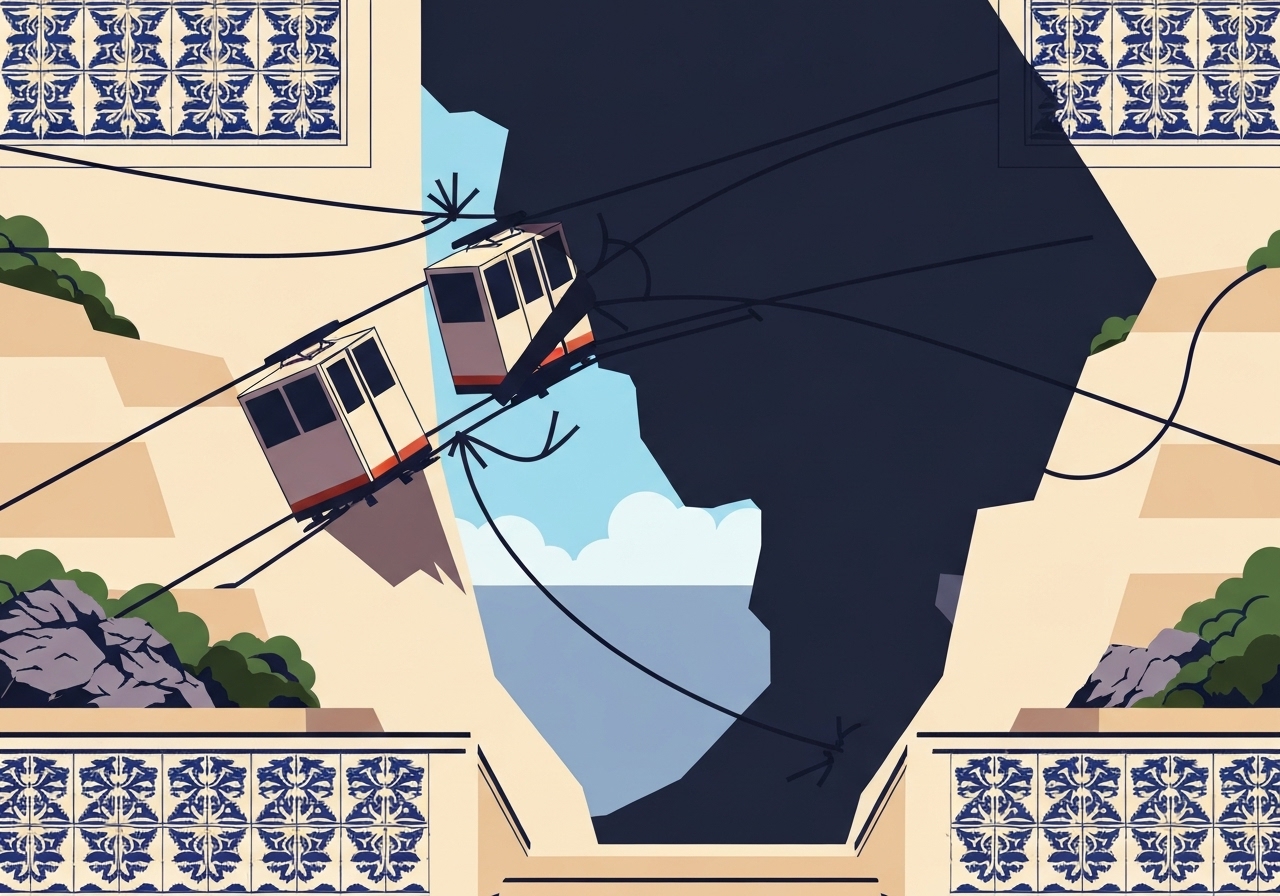
A historic funicular in Lisbon crashed on Wednesday, killing 16 people; recovery video and images showed a shredded underground cable linking the pair of counterbalanced cars, prompting investigators to focus on whether a cable failure or detachment triggered the disaster.
Key Takeaways
- Sixteen people were killed in the Lisbon funicular accident on Wednesday.
- Recovery footage released by Portuguese broadcasters appears to show a torn underground cable connecting the two cars.
- The two cars operate as counterweights on a single cable that passes over a pulley at the hilltop.
- Witnesses said the uphill car halted and fell back while the downhill car later became untethered and plunged a long distance.
- Carris, Lisbon’s public transport operator, says maintenance protocols were followed before the accident.
- An agency that investigates rail and aviation accidents said it will release initial findings Friday evening.
- Victims’ nationalities disclosed by judicial police include Americans, Brits, Canadians and others.
Verified Facts
Images and a short video published by SIC, a Portuguese television channel, show rescue workers handling badly damaged carriages and what appears to be a shredded cable that linked the two cars. The footage has been circulated by Portuguese media and cited by investigators as material for the probe.
The funicular’s two yellow cars serve as mutual counterweights: as one ascends the hill, the other descends. Each carriage holds about 40 passengers, and they normally pass each other roughly midway along the route.
Eyewitness accounts reported that the car traveling uphill stopped a few yards from the lower station and rolled back toward the base. At the same time, witnesses said the downhill car became untethered near the top of the line and suffered a longer free fall before striking a building.
The transport workers’ union identified the driver as André Jorge Gonçalves Marques. Portugal’s judicial police released the nationalities of the deceased: one American, five Portuguese, two South Koreans, one Swiss, three Britons, two Canadians, one Ukrainian and one French national.
Authorities involved in the inquiry include the office that investigates civil aviation and rail accidents; its director general said the agency will publish initial findings on Friday evening. Carris, the city operator, has stated publicly that maintenance checks and protocols were performed prior to the accident.
Context & Impact
The funicular is a historic and heavily used part of Lisbon’s transport network and a local landmark. A line closure and the shock of the casualties have prompted city officials to promise a review of safety measures and operations.
There is precedent for incidents on this line: in 2018 one car derailed and fell onto cobblestones without injuring passengers. At that time Carris described the event as caused by a technical issue; investigators are comparing maintenance records and past reports as part of the current probe.
Immediate impacts include suspension of the line, heightened inspections across similar systems in Portugal, and a judicial and technical inquiry that may influence regulatory oversight of heritage and urban transport lines.
Potential operational consequences
- Expanded safety audits for cable-driven systems nationwide
- Temporary suspension or reduced service on similar funiculars
- Possible revisions to maintenance and inspection intervals
“We will do everything so that from this tragic event we learn all the safety improvements to avoid similar accidents in the future,”
Director General, Portuguese Office for Aviation and Rail Accident Investigation
Unconfirmed
- Whether the cable actually detached from its anchorage or was severed by another mechanism remains under investigation.
- Initial media reports and some expert conjecture linking a single cable failure to the full sequence of events have not yet been confirmed by investigators.
- Detailed maintenance records and the precise condition of braking systems at the moment of the accident have not been released publicly.
Bottom Line
Images that show a badly damaged cable have sharpened attention on a possible mechanical failure as investigators work to corroborate witness accounts, maintenance logs and technical evidence. Authorities say a formal update will follow the first phase of the inquiry; meanwhile, local transport operators and regulators will face pressure to review safety practices for cable-driven lines.