
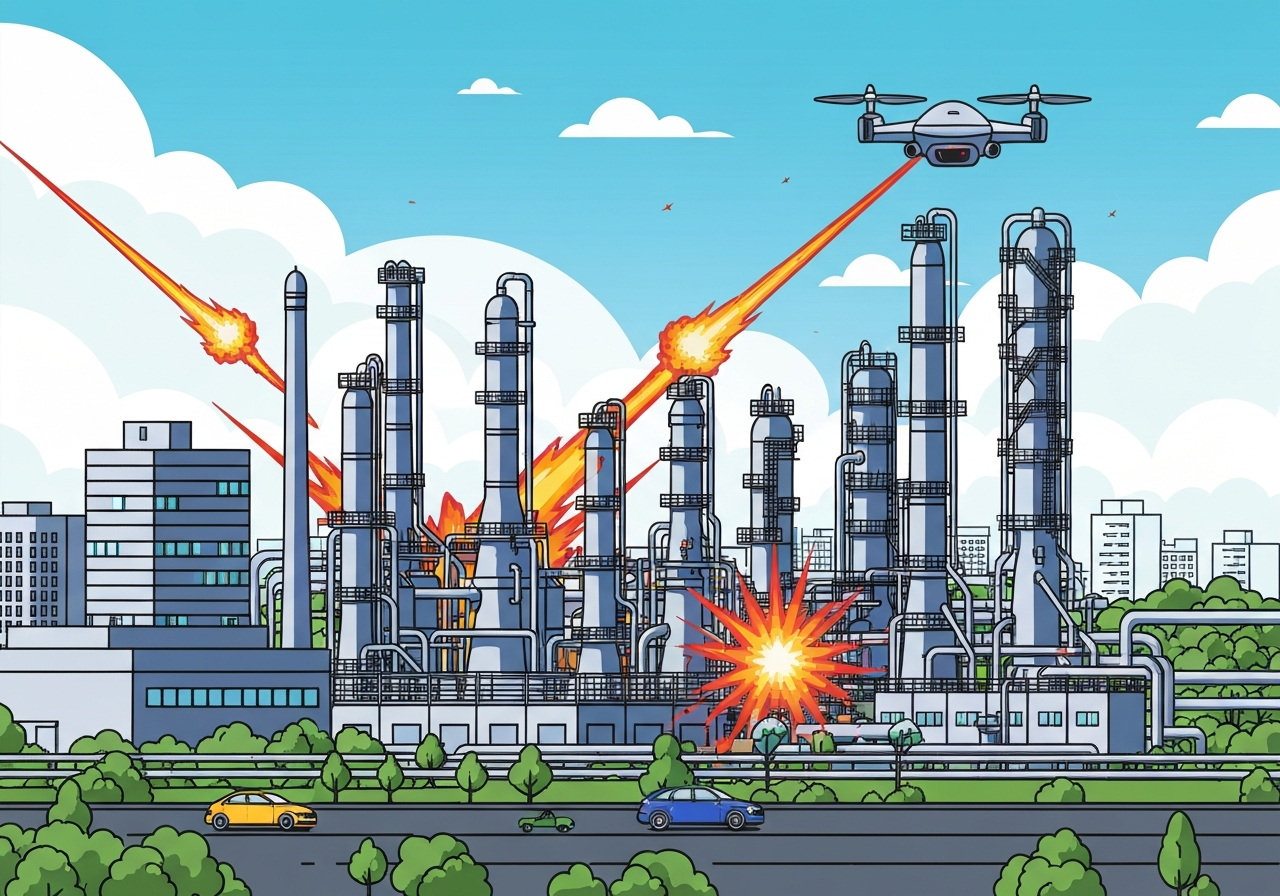
Thursday morning in south-east Moscow was shattered when a drone strike hit the Kapotnya oil refinery, sending thick black smoke across the skyline and damaging nearby shopping centres and residential blocks. Local officials say an eight-year-old girl died after a fire sparked by one of the strikes. The incident is among the largest aerial assaults on the Moscow region since Russia’s full-scale invasion of Ukraine and has rekindled debate inside Russia about the war’s domestic costs.
Key takeaways
- The strike struck the Kapotnya oil refinery in south-east Moscow on Thursday, producing visible plumes of black smoke across the city.
- Regional authorities reported damage to commercial and residential sites and an eight-year-old girl killed in a fire caused by a drone strike.
- Russian state and pro-Kremlin outlets framed the incident as limited domestic harm while emphasising damage Russia claims to be inflicting on Ukrainian targets.
- President Vladimir Putin did not publicly address the attack while attending a Russia–ASEAN summit in Kazan at the time, according to state reports.
- Russian officials signalled that counterstrikes on Ukraine will continue; the Kremlin spokesman said footage showing Russian strikes on Ukrainian cities will keep appearing.
- Analysts and some domestic commentators warn the strikes — especially on oil infrastructure — are increasing pressure on the Russian economy, with localized fuel shortages and rising pump prices reported.
Background
For much of the conflict, many residents of Moscow perceived the fighting as distant, even if government messaging stressed national mobilisation and support for the front. Over the past 18 months, the city has awoken to a series of shocks — high-profile assassinations of senior figures, and repeated reports of drones and long-range strikes reaching the capital region.
As those incidents accumulated, the boundary between the front line and civilian life narrowed. Moscow’s political and information environments have consistently presented the campaign as a necessary operation; state media and pro-Kremlin outlets typically emphasise Russian military effectiveness while attributing the longer duration of the war to Western support for Kyiv.
Main event
On Thursday, the Kapotnya refinery was struck in what local officials and several outlets described as a Ukrainian drone attack. The resulting fires were large enough to be seen from the Moscow ring road and produced widespread smoke that darkened parts of the city.
Authorities reported damage beyond the refinery: at least one shopping centre and several residential buildings were struck or affected by fires and debris. The governor of the Moscow region confirmed an eight-year-old girl was killed after a fire began following one of the strikes.
Eyewitness accounts collected near the site showed a mix of shock and quotidian response: some residents continued daily routines amid the smoke, while others described disbelief that the war had reached their neighbourhood. Local reportage described the scene as surreal — heavy smoke, emergency services on site, and bystanders watching from nearby blocks.
State television initially gave the incident limited coverage, and Russian newspapers published narratives minimising domestic damage while highlighting Russia’s own strikes on Ukrainian targets. When the Kremlin responded publicly, spokespeople reiterated that Russian strikes on Ukraine would continue and promised more footage of Russian operations would be released.
Analysis & implications
The strike marks a significant escalation in the psychological and material reach of the conflict for ordinary Muscovites. Attacks on energy infrastructure have a multiplier effect: they can disrupt fuel distribution chains, affect local economies, and amplify public perception that the war is no longer remote. Even isolated physical damage can therefore produce outsized political and economic consequences.
Economically, sustained attacks on oil facilities may worsen distribution bottlenecks. There are already reports of localized petrol shortages and rationing in some regions, and pump prices have been rising. If attacks broaden or supply lines suffer further disruption, the pressure could spread from regional markets to national fuel logistics.
Politically, Kremlin silence in the immediate aftermath and the tightly aligned domestic media narrative suggest a controlled response strategy: acknowledge the incident minimally while redirecting attention to Russian offensive claims. That approach may preserve short-term stability in public opinion but risks growing frustration if strikes and economic effects continue.
Internationally, the incident underscores Kyiv’s increasing use of long-range, precision and stand-off strike capabilities. Whether Kyiv continues such operations will depend on military calculus and western support; for Russia, it stresses the limits of geographic insulation and raises questions about homeland defence priorities.
Comparison & data
| Incident | Location | Reported impact |
|---|---|---|
| Kapotnya refinery strike (Thursday) | South‑east Moscow | Oil facility, shopping, residential damage; at least 1 child killed |
| Earlier incidents (past 18 months) | Moscow region | Assassinations, drone strikes, repeated security alerts — elevated threat profile |
The table places Thursday’s event in the context of an 18‑month trend of incidents reaching Moscow. While exact counts and damage totals for previous events vary by source, analysts note a clear increase in long-range strike attempts and political-targeted attacks in and around the capital.
Reactions & quotes
“These strikes will continue,”
Dmitry Peskov, Kremlin spokesman
Context: The Kremlin spokesman framed the attack as part of an ongoing campaign, emphasising Russian counter‑strikes and footage intended for domestic audiences.
“I saw explosions and lots of smoke — it looked like something from the movies,”
Slava, local resident
Context: An eyewitness described the visual shock from his apartment opposite the refinery and expressed surprise at the scale of the attack.
“It took us four years to win World War Two… I’m shocked this conflict endures,”
Nadezhda, local resident
Context: Another resident contrasted historical sacrifices with current expectations of swift resolution, expressing bewilderment about the war’s persistence.
Unconfirmed
- Attribution beyond initial reports: while multiple outlets described the incident as a Ukrainian drone attack, formal, public claim of responsibility by Ukrainian authorities had not been presented in available reporting at the time of publication.
- Exact scale of operational damage: official technical assessments of refinery output losses, storage damage and long‑term repair timelines have not been released publicly and remain unverified.
- Broader causation for reported fuel shortages: local reports cite petrol rationing and rising prices, but the precise contribution of this strike compared with pre-existing supply issues is not fully confirmed.
Bottom line
The Kapotnya refinery strike is a notable escalation that brings the conflict into Moscow’s urban space in a tangible way. Beyond the immediate human toll and property damage, attacks on energy infrastructure carry economic ripple effects and amplify public unease about the war’s reach.
How the Kremlin manages domestic messaging, emergency response and fuel logistics in the coming days will shape political and economic fallout. If such strikes continue, they could reshape both Moscow’s sense of security and the broader calculations of endurance on both sides of the conflict.
Sources
- BBC News — news media: original report summarising the attack, eyewitness accounts and official statements.