
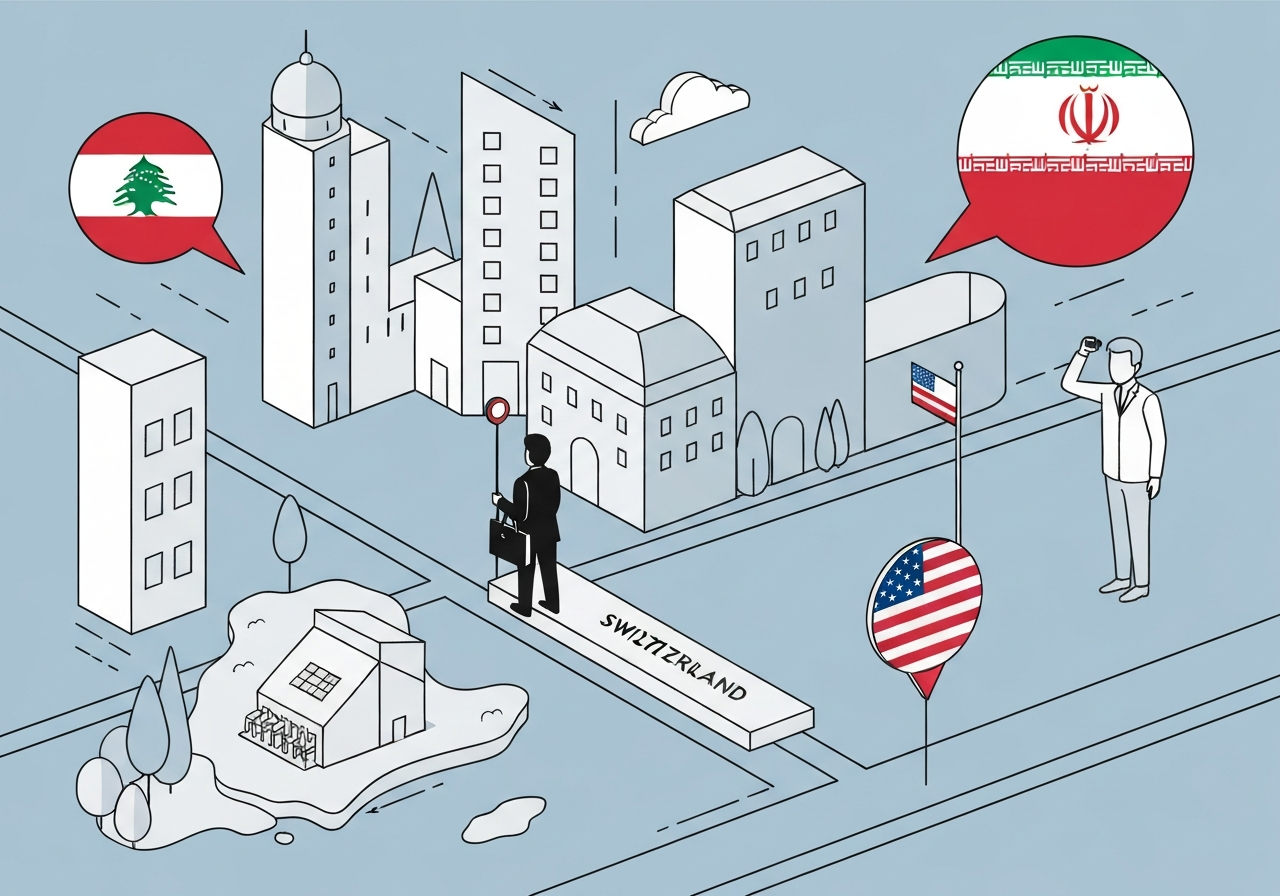
Who: US special envoy Steve Witkoff, joined by Jared Kushner and regional intermediaries; When: technical talks resumed after a postponement on June 20, 2026; Where: Swiss talks centered at Bürgenstock resort; What: renewed Israel-Hezbollah firefights in southern Lebanon have threatened a US-Iran memorandum of understanding signed June 17; Result: Washington is racing to salvage negotiations while renewed strikes in Lebanon killed five more people and earlier strikes left at least 47 dead.
Key Takeaways
- US envoy Steve Witkoff departed for Switzerland on June 20 to restart technical talks with Iran; Jared Kushner was expected to join those meetings.
- Renewed Israeli airstrikes in southern Lebanon killed five people on Saturday, following Friday strikes that Lebanese authorities said killed at least 47.
- Under the June 17 memorandum, a 60-day window is in place for negotiators to reach a final agreement; the timetable is under pressure after the Lebanon flare-up.
- Pakistan’s Interior Minister Mohsin Naqvi arrived in Mashhad to meet senior Iranian officials, including Abbas Araghchi and Eskandar Momeni, as Islamabad plays a mediating role.
- The Strait of Hormuz has reopened to commercial traffic; MarineTraffic and AXSMarine recorded at least 12 transits on Friday (5 tankers, 7 cargo), still far below the pre-war daily average of about 110 vessels.
- Iran has been tasked with mine clearance but has signaled permits and insurance will be required for ships, and Tehran’s Persian Gulf Strait Authority defined fixed transit routes near Larak Island.
- US domestic politics complicated diplomacy: Vice President JD Vance canceled a planned Switzerland trip, and President Donald Trump publicly reaffirmed ties with Prime Minister Benjamin Netanyahu while urging restraint.
Background
The United States and Iran signed a 14-point memorandum of understanding on June 17 that envisions a halt to hostilities across multiple fronts and steps aimed at reopening the Strait of Hormuz to commercial shipping. That framework relies not only on direct US–Iran commitments but also on influence over allied actors — notably Israel and Iran-backed groups in Lebanon — to prevent local flare-ups from undermining the deal.
Lebanon has no formal role in drafting the memorandum, yet its territory and armed actors are central to the agreement’s success. Israel’s military campaign against Hezbollah and reciprocal strikes inside Lebanon have repeatedly threatened to derail talks by creating acute security incidents that Tehran identified as preconditions for resuming negotiations.
Pakistan has acted as an intermediary since early stages of the talks; its Interior Minister Mohsin Naqvi’s visit to Mashhad is part of ongoing shuttle diplomacy intended to reassure Tehran and coordinate the technical elements required to resume discussions in Switzerland.
Main Event
Talks originally scheduled for Friday were postponed after a spike in hostilities between Israel and Hezbollah. US officials said the postponement followed large-scale Israeli strikes across southern Lebanon, which Lebanese authorities reported killed at least 47 people on Friday, making it one of the deadliest days since the March flare-up.
On Saturday renewed Israeli airstrikes struck the Nabatieh district and other towns — Arab Salim, Deir al-Zahrani and al-Dweir — killing five more people, according to Lebanon’s state-run National News Agency. The Lebanese army said the strikes threatened efforts to stabilize the country.
Israel’s military characterized its operations as responses to hundreds of projectiles and explosive drones aimed at soldiers and civilians, and said its forces targeted Hezbollah positions it described as terrorist infrastructure. Israeli officials maintained they would hold positions in southern Lebanon while saying they were prepared to observe a ceasefire if Hezbollah ceased hostilities.
After the weekend escalation, Washington said envoy Steve Witkoff would travel to Switzerland to reinstate technical negotiations; Jared Kushner, who helped shape the initial MOU, was reported expected to join. Swiss authorities confirmed preparatory work at the Bürgenstock resort was continuing.
Analysis & Implications
The Lebanon front is a critical stress test for the US-Iran accord because it pits a deniable proxy contest against formal state-to-state diplomacy. Even if Tehran and Washington agree on technical steps — such as mine clearance and deconfliction mechanisms for shipping — localized combat between Israel and Hezbollah can produce incidents that prompt Iran to pause cooperation or harden demands.
Domestically, Israel’s actions complicate US leverage. The memorandum depends on allied restraint; persistent Israeli operations can be read by Iranian negotiators as a lack of credible guarantees that the conflict will stop, justifying Tehran’s caution. Conversely, US pressure on Israel risks political friction with one of Washington’s closest partners, as seen in public rebukes and tense exchanges among officials.
Economically, reopening the Strait of Hormuz would ease some pressure on global energy markets, but demining and route verification are technical tasks that require time. Experts warn mine clearance could take weeks; Iran’s requirement for permits and insurance, and the PGSA’s fixed-route mandates, will affect shipping costs and insurer willingness to resume normal operations quickly.
Geopolitically, the episode has highlighted the limits of unilateral military leverage and the importance of multilateral mediation. Pakistan’s active diplomacy and Switzerland’s facilitation underscore the role smaller states can play in negotiating technical compromises between major adversaries.
Comparison & Data
| Metric | Recent Value | Pre-war Baseline |
|---|---|---|
| Vessels through Strait (sample day) | 12 (5 tankers, 7 cargo) — Friday | ~110 vessels/day (pre-war average) |
| Lebanon deaths (Friday) | At least 47 | — |
| Additional Lebanon deaths (Saturday) | 5 | — |
| Negotiation deadline | 60 days from framework signing (June 17) | — |
These figures show maritime traffic remains a fraction of normal levels even after the agreement opened the strait. Casualty counts from the Lebanon strikes underscore the volatility on the ground; both trends create political pressure that will shape technical negotiations over the coming weeks.
Reactions & Quotes
“I’ve always been good with Bibi. You just gotta calm down sometimes and use your head.”
President Donald Trump (interview excerpt)
Trump publicly reaffirmed his relationship with Prime Minister Benjamin Netanyahu while urging Israeli restraint in remarks to US media, signaling Washington’s attempt to balance alliance solidarity with pressure to de‑escalate.
“We will abide by the ceasefire if Israel abides by it, and we have the right to respond.”
Ibrahim al‑Moussawi (Hezbollah parliamentary member)
Hezbollah spokespeople expressed conditional acceptance of the truce, emphasizing reciprocal obligations and reserving retaliatory rights if they judged Israel to have violated terms.
“The continuation of Israel’s aggression is aimed at derailing any solution that allows for the restoration of stability in Lebanon.”
Lebanese Army statement
Lebanese official statements framed the strikes as an obstacle to stabilization and to broader diplomatic efforts tied to the US‑Iran understandings.
Unconfirmed
- Whether Israel’s most recent strikes were intended to deliberately disrupt the Swiss negotiations remains unproven and is disputed by Israeli officials who say the strikes were retaliatory.
- Reports that a comprehensive, enforceable demining timeline has been agreed between Washington and Tehran have not been independently verified.
- Claims that the PGSA’s permit regime will be enforced uniformly for all flagged vessels have not been tested in extended commercial transits.
Bottom Line
The diplomacy surrounding the US‑Iran memorandum is fragile: technical talks in Switzerland are politically feasible but remain vulnerable to kinetic events on the Lebanon front. Restarting negotiations will require both tangible confidence‑building measures — such as verified pauses in cross‑border strikes — and firm, multilateral mechanisms to manage maritime safety in the Strait of Hormuz.
Practical progress in the coming days will hinge on whether Israel and Hezbollah adhere to the renewed ceasefire and whether Iran judges those commitments credible enough to resume detailed technical work. If violence recurs, the 60‑day negotiating clock will remain at risk, increasing the chance that the interim arrangement will not yield a durable final deal.