
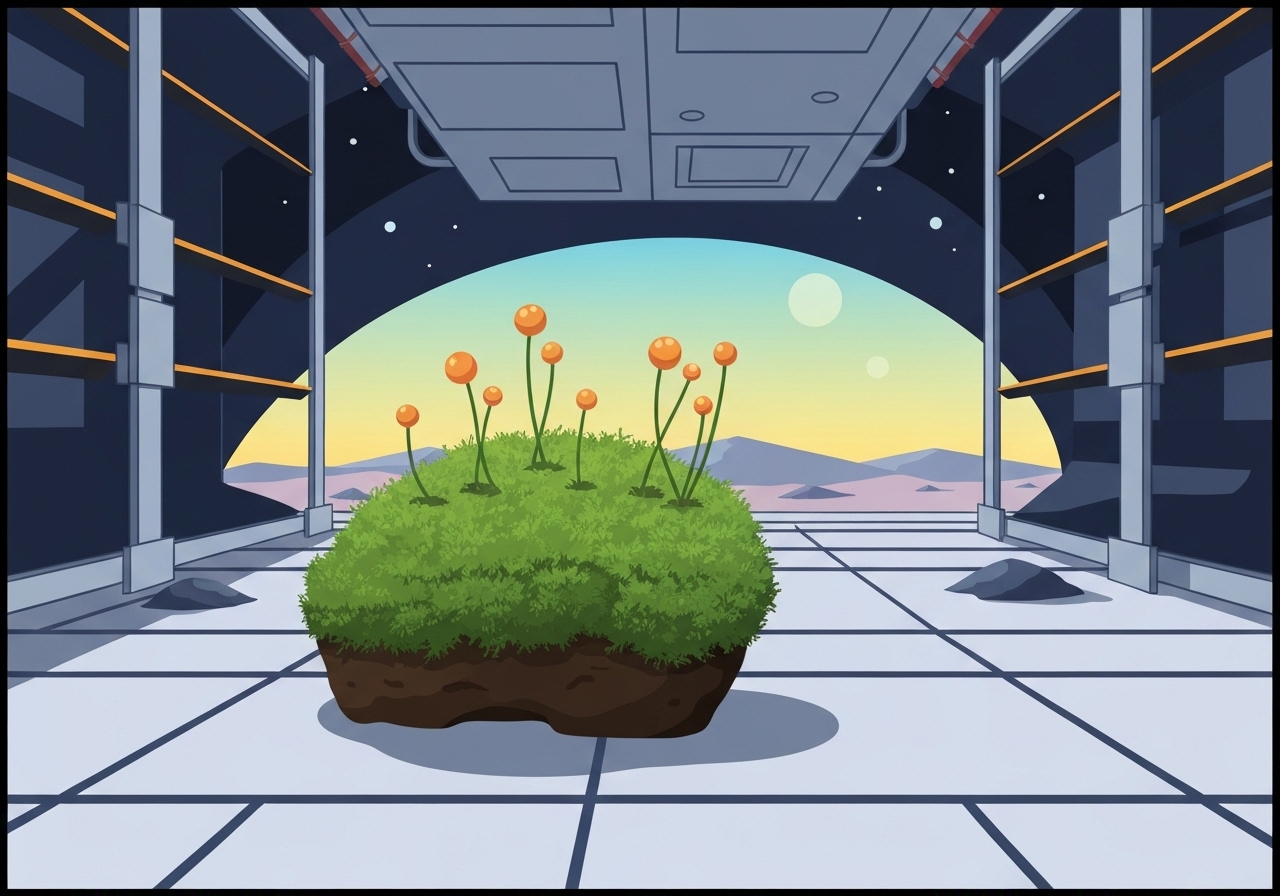
Lead: In 2022, researchers attached hundreds of moss sporophytes to the exterior of the International Space Station for 283 days and then returned them to Earth. A study published in iScience reports that more than 80% of the spores survived the nine-month exposure, and nearly 90% of those surviving spores were able to germinate again in laboratory conditions. The experiment tested resilience to vacuum, extreme temperatures and ultraviolet radiation and found that the sporophyte structure likely contributed to protection. Authors say the results have implications for long-duration space agriculture and the study of life’s limits in extraterrestrial environments.
Key Takeaways
- Exposure duration: Moss sporophytes remained on the ISS exterior for 283 days (March 2022–January 2023) before return on a SpaceX cargo mission.
- Survival rate: Over 80% of dispatched Physcomitrium patens spores survived the nine-month external exposure.
- Germination success: Of the surviving spores, almost 90% germinated in lab tests after return to Earth.
- Thermal tolerance: In ground simulations, spores withstood sustained heat (131°F for one month) and extreme cold (−320°F for over a week).
- Biological mechanism: The study identifies the sporophyte encapsulation as a likely UV- and desiccation-protective adaptation.
- Potential longevity: Authors suggest, based on extrapolation, that moss could possibly survive in space for up to ~15 years, though that estimate requires further testing.
Background
Mosses are among the earliest groups of land plants, with ancestral lineages moving from aquatic to terrestrial environments around 450 million years ago. Their ecological range today spans Antarctic tundra, high mountain slopes, volcanic fields and diverse aquatic habitats, reflecting wide physiological tolerance. Researchers interested in astrobiology and space agriculture selected Physcomitrium patens because its life cycle includes resilient sporophytes—encapsulated reproductive units that are naturally adapted to survive desiccation and high UV exposure. Prior experiments have tested plants inside pressurized modules on the ISS; this test placed material fully exposed to vacuum and unshielded radiation to probe extreme survivability.
The team from Hokkaido University led by Tomomichi Fujita first validated survivability in Earth-based simulated conditions—vacuum chambers, UV lamps and thermal cycling—before sending samples on a Northrop Grumman cargo craft to the station in March 2022. Astronauts mounted the sporophyte samples on the station exterior; they stayed attached through orbital rotations, solar exposure cycles and micrometeoroid/debris environment for 283 days. Samples were returned to Earth on a SpaceX cargo flight in January 2023 and analyzed under controlled laboratory conditions to assess viability and reproductive capacity.
Main Event
In the March 2022 campaign, researchers loaded hundreds of Physcomitrium patens sporophytes into an external exposure fixture and shipped them to the ISS aboard a Northrop Grumman resupply vehicle. Station crew installed the fixture outside the pressurized module, exposing the specimens to vacuum, cosmic radiation and thermal extremes as the station orbited Earth roughly every 90 minutes. After 283 days on the station exterior, the samples re-entered Earth-return logistics and were retrieved in January 2023 following arrival on a SpaceX cargo mission.
Laboratory assays conducted after return measured survival by viability staining and germination trials. The study reports that over 80% of the spores remained viable after external exposure and that nearly 90% of those viable spores germinated under Earth lab conditions. Researchers also examined spore structure microscopically and concluded that the outer layers of the sporophyte likely attenuated harmful ultraviolet wavelengths and mitigated desiccation damage.
Lead author Tomomichi Fujita described the results as unexpected: the team had anticipated very low survival given vacuum and high UV flux on the station exterior, but most sporophytes persisted and reproduced. The paper links this resilience to evolutionary adaptations that helped early land plants survive periods of environmental stress on Earth, suggesting those same traits confer some protection in near-Earth space.
Analysis & Implications
The experiment demonstrates that some terrestrial reproductive cells can survive direct exposure to low Earth orbit conditions for months, challenging assumptions about cellular vulnerability in vacuum and high-UV settings. For astrobiology, this raises questions about the durability of biological material in space and the mechanisms that permit long-term persistence. The sporophyte’s protective layers appear to be a key factor, indicating that structural rather than metabolic adaptations can determine survival across extreme environments.
For space exploration and in-situ resource use, the findings open a possible pathway toward biological experiments and limited agricultural concepts outside pressurized habitats. If spores or hardy propagules can survive and later germinate, they could serve as compact biological payloads for closed-loop systems or for testing regolith-based growth on lunar or Martian surfaces. However, engineering practical cultivation systems will require demonstrated vegetative growth stages, not only spore survival and germination.
There are also planetary protection and contamination implications: elevated survival of Earth-origin spores in space increases the importance of strict sterilization protocols for spacecraft destined to other worlds. The study does not show moss can establish ecosystems on the Moon or Mars, but it does argue that life’s building blocks can endure transit and harsh exposure, which must inform both forward-contamination safeguards and sampling-return containment practices.
Comparison & Data
| Metric | Value |
|---|---|
| Exposure duration | 283 days (March 2022–Jan 2023) |
| Initial samples sent | Hundreds of sporophytes (exact count in study) |
| Post-flight survival | >80% |
| Germination of survivors | ~90% |
| Ground thermal tests | 131°F (30 days); −320°F (7+ days) |
The table summarizes key quantitative outcomes reported by the authors. These figures show robust post-exposure viability and high germination efficiency among survivors, supporting the conclusion that sporophyte morphology contributes materially to resistance against UV and desiccation. The study provides raw counts and experimental protocols in its methods section for reproducibility; readers interested in technical details should consult the published paper.
Reactions & Quotes
“Most living organisms, including humans, cannot survive even briefly in the vacuum of space. This provides striking evidence that the life that has evolved on Earth possesses, at the cellular level, intrinsic mechanisms to endure the conditions of space.”
Tomomichi Fujita, lead author, Hokkaido University
“We expected almost zero survival, but the result was the opposite: most of the spores survived.”
Tomomichi Fujita, lead author, Hokkaido University
The first quote frames the experiment’s broader significance for cellular resilience in space; the second communicates the team’s surprise relative to prior expectations. These statements come from the study authors and affiliated institutional communications; independent replication and additional exposure durations will be needed to generalize the findings.
Unconfirmed
- The projection that moss could survive up to roughly 15 years in space is an extrapolation by the authors and remains untested experimentally at that timescale.
- Whether moss can establish sustained growth or form self-supporting ecosystems on the Moon or Mars is not demonstrated by this spore-survival experiment.
- The degree to which external ISS exposure replicates deeper-space radiation spectra and micrometeoroid flux is partial; differences could change survival outcomes beyond low Earth orbit.
Bottom Line
This experiment provides robust, peer-reviewed evidence that Physcomitrium patens sporophytes can survive nine months of direct exposure outside the International Space Station and remain capable of germination once returned to Earth. The result highlights how ancient adaptations for desiccation and UV protection can also confer resilience in near-Earth space environments.
While the findings expand the known limits of terrestrial life and suggest potential uses for compact biological payloads, they do not yet demonstrate the feasibility of off-world agriculture or ecosystem construction. Follow-up work should test longer exposures, assess vegetative growth stages, and evaluate implications for planetary protection policy.