
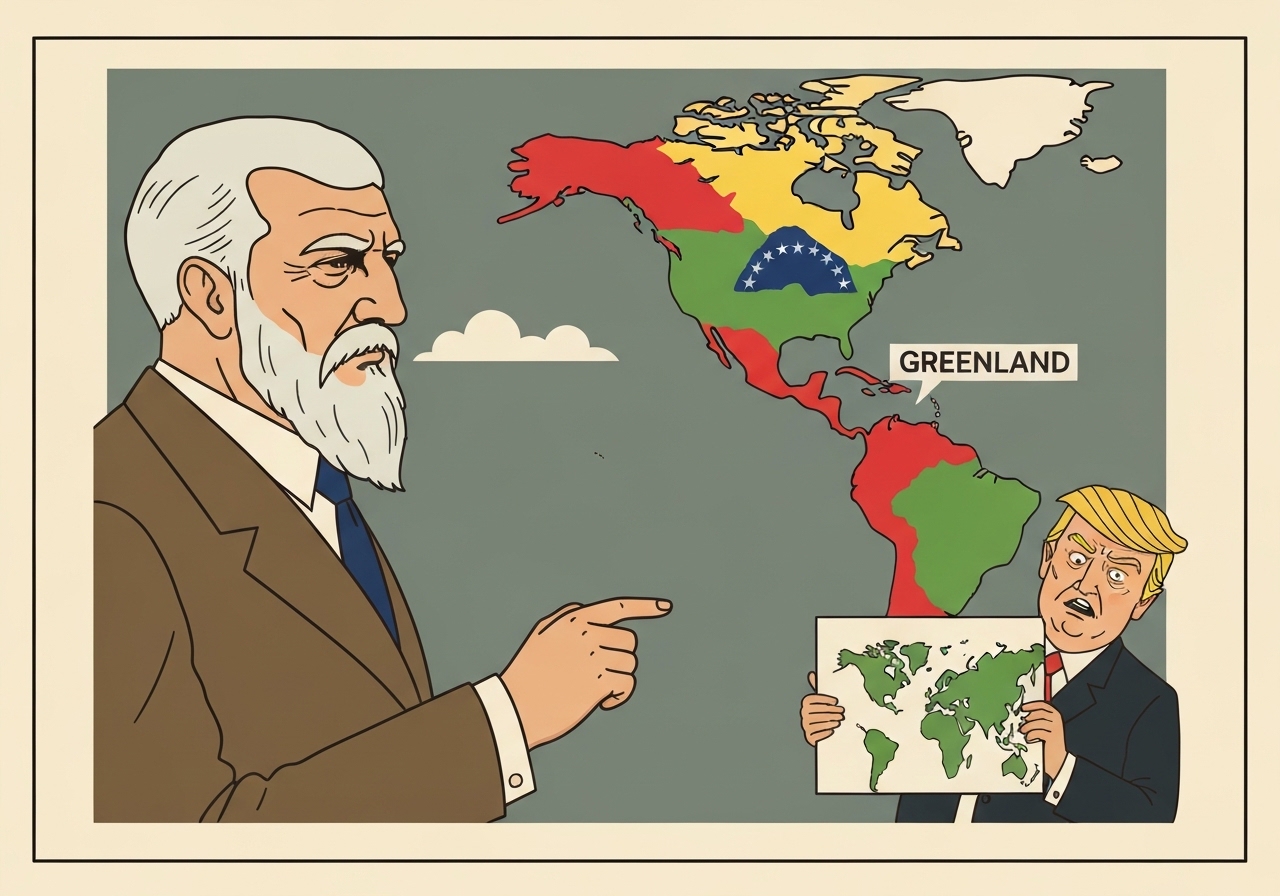
Lead: In mid-January 2026, President Donald Trump repeatedly invoked long-standing U.S. doctrines to justify aggressive actions abroad, citing the Monroe Doctrine and Teddy Roosevelt–era approaches while defending moves toward Venezuela and public pressure over Greenland. His statements framed intervention and coercion as continuations of 19th- and early-20th-century U.S. policy, while critics and historians say the methods and sequencing differ sharply from the originals. The debate centers on whether Trump is reviving historic hemispheric claims or simply borrowing old language to rationalize a more blunt, transactional foreign policy.
Key Takeaways
- President Trump in January 2026 referenced the Monroe Doctrine to defend alleged U.S. action involving Venezuelan President Nicolás Maduro, framing it as a response to violations of hemispheric norms.
- The Monroe Doctrine, proclaimed in 1823 by President James Monroe, warned European powers against expanding influence in the Western Hemisphere and established a U.S. regional posture.
- Theodore Roosevelt reworked the doctrine in 1904 as the Roosevelt Corollary, endorsing a U.S. “international police” role in Latin America in cases of chronic instability.
- Roosevelt favored diplomacy first and force as a last resort—his 1907 Great White Fleet demonstration was deterrent posturing, not a war declaration.
- Scholars quoted in reporting say Trump emphasizes force and transactional leverage over patient diplomacy, reversing Roosevelt’s stated priorities.
- Woodrow Wilson expanded naval-backed interventions (“gunboat diplomacy”) in the Caribbean and Central America, showing how the doctrine has been adapted across presidencies.
- Historians warn Trump selectively borrows historical precedent—what they call “cherry-picking”—rather than following the legal or diplomatic norms those presidents sometimes supported.
- Several claims around recent Venezuelan operations and Greenland negotiations are disputed or lack independent confirmation and are listed below as unconfirmed.
Background
The Monroe Doctrine originated in President James Monroe’s 1823 annual message to Congress, asserting that European intervention in the Americas would be considered hostile to U.S. interests. At the time, Spain and other European powers were ceding or contesting territories in the Western Hemisphere, and the United States was positioning itself as the primary regional actor. Historians view the doctrine as a flexible principle that later administrations could reinterpret to suit changing geopolitical circumstances.
By the early 20th century President Theodore Roosevelt reframed that framework in response to crises such as European blockades of Venezuelan ports over debt disputes. Roosevelt’s 1904 message to Congress articulated a willingness—reluctant but real—to use U.S. power to prevent chronic wrongdoing and instability in neighboring states. The resulting Roosevelt Corollary justified interventions intended to stabilize countries in the Caribbean and Central America, often to protect U.S. strategic and economic interests.
Main Event
In January 2026 President Trump repeatedly referenced these historical doctrines at a news conference and in public statements while defending recent hardline posture on Venezuela and public overtures toward Greenland. He characterized the Monroe Doctrine as central to U.S. hemispheric policy and suggested it justified recent actions aimed at Nicolás Maduro’s government. Trump also used hyperbolic language to rebrand the doctrine in remarks, signaling a modern, personalized reading of old principles.
Observers say the tactics—public pressure, rapid military signaling and implicit threats—resemble early-20th-century practices but invert the diplomatic sequence that Roosevelt described. Where Roosevelt emphasized patient diplomacy backed by credible force, critics contend Trump prioritizes coercion and treats military or overt pressure as the primary lever. That distinction shapes both the legal and reputational consequences of U.S. moves in the region.
The administration’s handling of Greenland negotiations was presented in the same transactional tone: officials boasted of pressing for territorial or economic advantage, echoing past U.S. efforts to secure strategic footholds. International responses ranged from irritation to alarm as allies and regional governments weighed whether U.S. rhetoric signaled revival of hemispheric dominance or opportunistic bargaining.
Analysis & Implications
Recasting historical doctrine matters because it shapes expectations about U.S. behavior. The Monroe Doctrine began as a prohibition on European expansion into the Americas; over time it became a rationale for U.S. interventions. When leaders invoke it today, they are not just citing history—they are signaling a willingness to assert influence in ways that can alter regional balances and provoke countermeasures from other powers.
Theodore Roosevelt’s version—sometimes called the Roosevelt Corollary—was explicitly about policing regional stability and preserving U.S. strategic interests. Roosevelt nonetheless paired his firmness with support for international arbitration in many disputes. Contemporary analysts note that Trump’s approach appears to strip away some of those legal or multilateral veneers, favoring unilateral measures and transactional deals.
There are practical risks. Moving from rhetoric to action without clear diplomatic groundwork can create legal vulnerabilities, escalate conflicts, and strain alliances. Latin American governments, European partners and other global actors may respond by diversifying security and economic ties away from the United States, potentially opening spaces for rivals to expand influence in the hemisphere.
Comparison & Data
| President / Era | Characteristic | Typical Tool |
|---|---|---|
| James Monroe (1823) | Hemispheric warning to Europe | Diplomatic proclamation |
| Theodore Roosevelt (1904) | Corollary: “police” role | Limited military intervention, deterrence |
| Woodrow Wilson (1910s) | Gunboat diplomacy | Naval force, occupations |
| Donald Trump (2020s) | Transactional coercion | Public pressure, threats, military signaling |
The table above summarizes dominant tendencies across administrations. While all four presidents used the language of influence and security, the balance between diplomacy, legal frameworks and force has varied. Modern policy debates hinge on whether hard power is used as a last resort (as Roosevelt claimed) or as an early lever (how critics describe the Trump-era posture).
Reactions & Quotes
Historians and policy experts reached for historical parallels but warned against simplistic equivalence. Before his comment, scholars emphasized context: past leaders coupled force with diplomatic institutions in ways that are not mirrored today.
“Roosevelt believed advances came from slow, patient diplomacy, not constant military action,”
Jon Alterman, Center for Strategic and International Studies (think tank)
Alterman’s point was that Roosevelt used force as part of a broader strategy, not as the primary, routinized tool. He emphasized the difference between demonstrating strength and using it as a first resort.
“Trump often treats diplomacy as slow and imperfect, and he favours the clarity of force,”
Jon Alterman, Center for Strategic and International Studies (think tank)
Other historians cautioned that Trump selectively draws on past presidents for rhetorical cover.
“He cherry-picks convenient parts of American history rather than following the legal principles Roosevelt sometimes endorsed,”
Douglas Brinkley, Rice University (academic)
Brinkley argued that invoking Roosevelt for credit or comparison overlooks crucial differences in legalism and multilateral engagement.
Unconfirmed
- Reports that U.S. troops captured Venezuelan President Nicolás Maduro were asserted by the president in public remarks; independent, verifiable confirmation of a U.S. capture was not available at the time of reporting.
- Details about private negotiations or offers to purchase Greenland remain partly opaque; the precise terms and any formal offers cited in public comments lack full documentary disclosure.
Bottom Line
Invoking the Monroe Doctrine and Theodore Roosevelt gives contemporary U.S. leaders a powerful historical frame, but the substance of policy matters more than the rhetoric. Roosevelt’s model emphasized diplomacy backed by credible force and often worked within norms of arbitration and legalism; critics say the current approach privileges immediacy and leverage over patient statecraft.
If the United States leans into a pattern of early coercion, it risks legal challenges, diplomatic fallout and the loss of regional goodwill that helps sustain long-term influence. Close observers should watch whether the administration pairs its rhetorical claims with transparent diplomatic efforts and multilateral engagement—or whether history is being used primarily as a pretext for unilateral pressure.
Sources
- NPR — (media report summarizing statements and expert commentary)
- Kinder Institute on Constitutional Democracy, University of Missouri — (academic institute; Jay Sexton commentary)
- Center for Strategic and International Studies (CSIS) — (think tank; Jon Alterman profile and analysis)
- Rice University — (academic; Douglas Brinkley commentary on presidential history)
- Dickinson State University — (academic; Michael Cullinane, Theodore Roosevelt studies)