
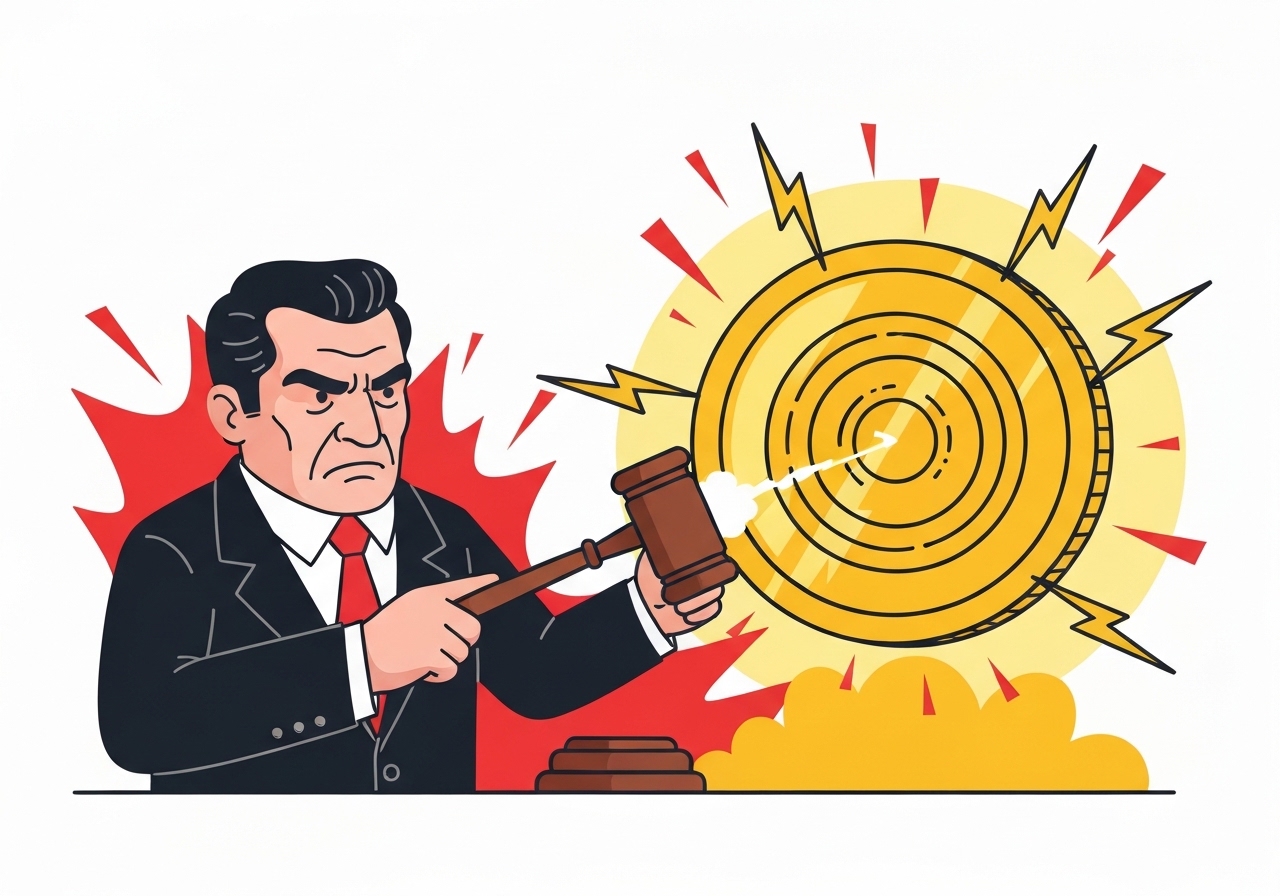
Trump’s Justice Department Targeted the Fed — and It Backfired
Lead: On January 15, 2026, a Justice Department inquiry into Federal Reserve Chair Jerome Powell — centering on a multibillion‑dollar renovation of the Fed headquarters in Washington, D.C. — exploded into a national controversy. Prosecutors in the District of Columbia served grand jury subpoenas, prompting Powell to publicly decry the move as political pressure. The investigation produced rapid bipartisan pushback, threatened the administration’s plans for Fed leadership, and, paradoxically, bolstered the chair’s standing and the institution’s claim to independence.
Key Takeaways
- The Department of Justice opened a criminal inquiry that led to grand jury subpoenas served to the Federal Reserve on a Friday; the action became public on January 15, 2026.
- The probe centers on a renovation project whose total cost is estimated at about $2.5 billion, roughly $700 million higher than earlier budget figures.
- Jeanine Pirro, the U.S. attorney for the District of Columbia, is reported to have initiated the inquiry after reviewing press coverage; she oversees the Fed’s jurisdiction.
- White House allies, including an adviser identified as Bill Pulte, pressed the administration to pursue aggressive legal steps against perceived political opponents.
- Major Republican figures in Congress, including Senator Thom Tillis and other GOP voices, publicly criticized the move and warned they would block confirmation votes for Fed nominees if the effort continued.
- Markets showed relatively muted immediate reaction, in part because bipartisan criticism reassured investors worried about a sudden end to Fed independence.
Background
For months President Trump had been pressing the Federal Reserve to cut interest rates more quickly, citing affordability concerns and weaker momentum in parts of the labor market. The Fed reduced rates at three consecutive meetings, but the president judged those moves insufficient and repeatedly targeted Chair Jerome Powell for public rebuke. That persistent pressure formed the political backdrop for a campaign to find leverage that could force a change in policy or personnel at the central bank.
One focus became the Fed’s major renovation of century‑old buildings in Washington, a lengthy project that required specialized preservation work and faced rises in material and labor costs. Reported project estimates converged around $2.5 billion, and coverage emphasizing a roughly $700 million overrun provided a new opening for critics to frame the work as mismanagement. Cost overruns in large public construction projects are common and are not in themselves evidence of criminal conduct; still, in this case the figures offered a pretext for political opponents to press legal avenues.
Main Event
According to reporting, Jeanine Pirro began a preliminary inquiry in the fall and by December her office had sent two requests for information to the Federal Reserve, one around December 19 and a follow‑up near December 29. Those requests were described internally as politely worded and did not mention subpoenas or a formal criminal investigation at the time. The Fed did not treat the correspondence as an urgent legal demand and did not immediately provide the materials sought over the holiday period.
Days later, the Department of Justice escalated. Federal prosecutors in Washington served grand jury subpoenas on the Fed, and the revelation prompted Jerome Powell to release a short recorded statement directly addressing the public. Powell framed the move as unrelated to his June testimony and said the legal action was, in effect, a pretext for exerting political pressure on monetary policy.
The White House response was mixed. President Trump continued to assail Powell in public remarks, describing the cost figures as evidence of incompetence or wrongdoing, while some advisers and agencies pushed the line that the administration was not directing prosecutors. Within hours of the story breaking, a stream of criticism came from Republican senators, former Trump economic aides, and conservative media, arguing that the Justice Department had overreached.
Facing swift backlash, U.S. Attorney Pirro publicly softened her rhetoric, characterizing the office’s initial steps as an inquiry rather than an imminent prosecution. Still, the subpoenas had already altered the dynamics of Fed succession planning and the politics of confirmations in the Senate.
Analysis & Implications
The episode highlights the institutional tension between an independent central bank and a politically aggrieved presidency. By routing pressure through the Justice Department, the administration sought leverage beyond rhetorical attacks; the legal approach threatened to transform policy disagreement into criminal exposure. That strategy risked eroding long‑standing norms protecting monetary policymaking from day‑to‑day political influence.
Politically, the maneuver appears to have backfired. Key Republican lawmakers worried that pursuing a criminal case against a sitting Fed chair would destabilize markets and complicate the party’s electoral prospects ahead of midterms. Several senators signaled they would withhold support for confirming alternative Fed leadership while the probe proceeded, which could leave the central bank with fewer slots to fill and slow any effort to repopulate its governing board.
Strategically for the Fed, the incident strengthened claims of institutional independence. Powell’s decision to address the public directly reframed the narrative from one of alleged malfeasance to one of political interference. That reframing encouraged a coalition of lawmakers, market participants, and former administration officials to defend the Fed’s role in setting policy based on economic evidence rather than political expediency.
Economically, markets initially showed only limited disruption, partly because the bipartisan pushback reassured investors. But the episode raises a longer‑term risk: repeated attempts to subordinate monetary policy to short‑term political aims would undercut confidence in the dollar and Treasury markets if they became credible. For now, the immediate result has been to make Fed independence a salient bipartisan cause.
Comparison & Data
| Item | Figure (approx.) |
|---|---|
| Initial budget estimate | $1.8 billion |
| Current estimated total cost | $2.5 billion |
| Approximate overrun | $700 million |
Context: the table above reconstructs the math discussed in reporting: a project now estimated at roughly $2.5 billion that sits about $700 million above earlier budgetary expectations, implying an initial planning figure in the neighborhood of $1.8 billion. Those totals reflect work on historic structures with preservation needs, which raises baseline costs. Officials and contractors also cited elevated material and labor prices as contributors to the gap. Importantly, cost escalation on large, older‑building renovations is not uncommon and does not automatically indicate criminal intent.
Reactions & Quotes
Powell chose to speak directly to the public, an uncommon step for a central banker, seeking to make the case that the subpoenas were part of a political project to shape monetary policy.
‘This is about whether the Fed will be able to continue to set interest rates based on evidence and economic conditions.’
Jerome Powell, Federal Reserve
Republican lawmakers quickly pushed back against the Justice Department’s move, arguing it threatened institutional stability and could imperil confirmation votes needed to staff the Fed.
‘I’m not going to consider Fed confirmations while this is ongoing.’
Senator Thom Tillis (R‑NC)
The president continued to criticize Powell, framing the renovation figures as proof of mismanagement even as allies inside and outside the administration counseled caution.
‘Either incompetent or crooked,’
President Donald J. Trump
Unconfirmed
- Whether the renovation cost overruns include actionable criminal conduct remains unproven; no public indictment has been filed.
- The precise contents and tone of the December letters from the U.S. attorney’s office to the Fed have not been publicly released and are subject to differing descriptions.
- The extent and exact nature of Bill Pulte’s role in advocating for investigations into political opponents, including his influence on the president in this matter, remains partially reported but not fully documented.
Bottom Line
The Justice Department inquiry into the Fed was intended to amplify pressure on Chair Powell and, by extension, on monetary policy. Instead, public disclosure of subpoenas prompted rapid bipartisan defense of Fed independence, complications for the administration’s ability to staff the central bank, and a reputational boost for Powell and the institution he leads.
That dynamic underscores a wider lesson: efforts to instrumentalize law enforcement for political ends can provoke institutional pushback that undermines the original objective. In this case, the short‑term aim of exerting leverage over interest rates risks producing the opposite outcome — a stronger, more defended central bank and a more fraught path to replacing its leadership.