
Lead
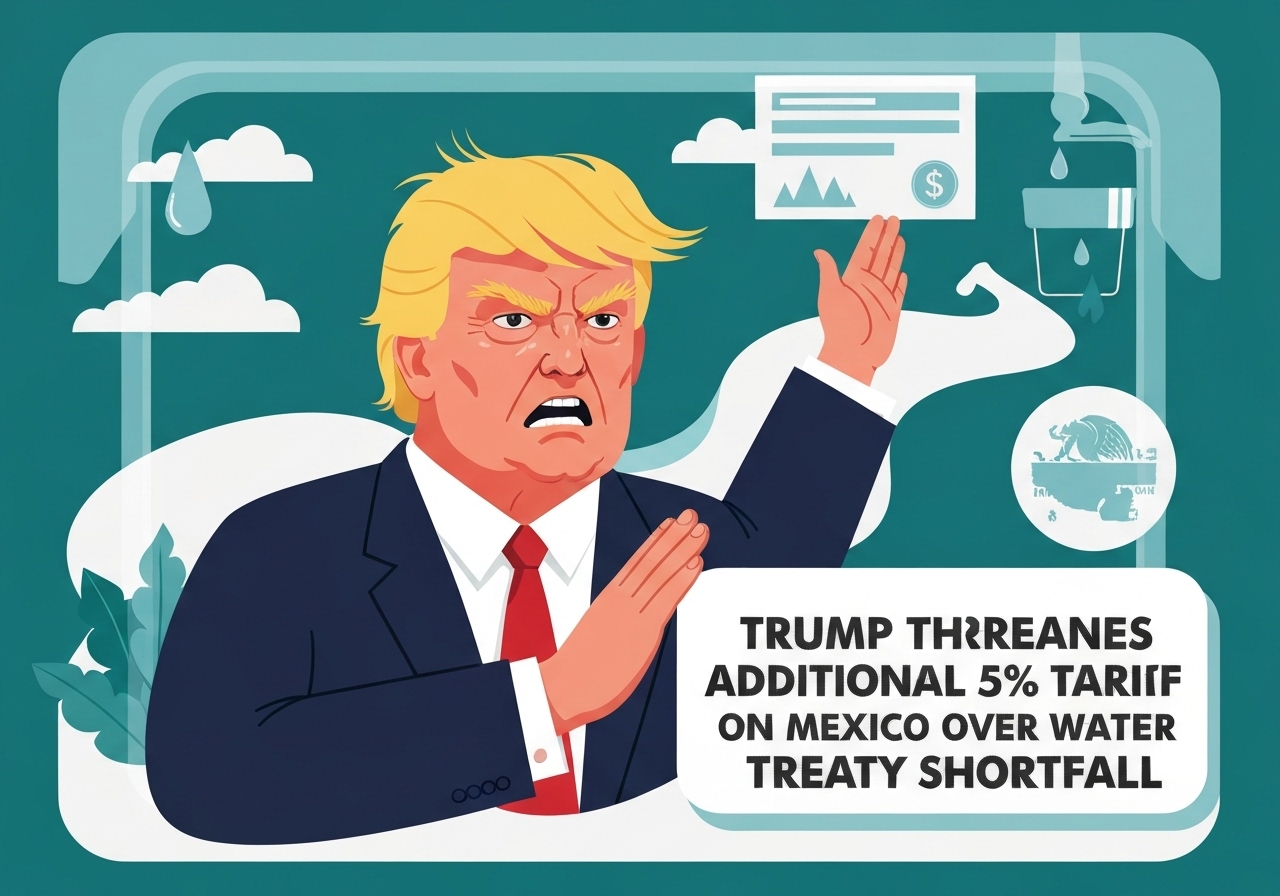
— President Donald J. Trump announced a new threat to impose a 5 percent tariff on Mexican imports, citing Mexico’s alleged failure to deliver more than 800,000 acre-feet of water under the 1944 U.S.–Mexico water treaty. The message, posted on social media, demanded Mexico release 200,000 acre-feet by Dec. 31 and make up the remainder soon after. The announcement escalates a months-long dispute over shared river flows in border states including Chihuahua, Texas and New Mexico and risks widening trade friction between the two countries.
Key Takeaways
- President Trump threatened an additional 5% tariff on Mexican goods on Dec. 8, 2025, citing a shortfall under the 1944 treaty.
- The administration says Mexico withheld more than 800,000 acre-feet of water (about 260 billion gallons); the president demanded 200,000 acre-feet by Dec. 31.
- If applied, the extra tariff could push Mexico’s maximum nominal tariff rate to 35%, matching a recent action on Canada.
- Mexico’s President Claudia Sheinbaum has acknowledged falling short of treaty deliveries, blaming an extended drought that has since eased.
- Earlier in 2025 Sheinbaum temporarily transferred reserves and increased U.S. Rio Grande deliveries through October after an April row with the U.S.
- Mexican farmers have resisted further concessions; protests have included a 2020 dam seizure and recent blockades that halted roughly 7,000 trucks in Juárez.
- Experts say long-term climate shifts and higher temperatures are intensifying cross-border water stress and complicating treaty compliance.
Background
The dispute centers on a 1944 treaty that allocates flows from the Rio Grande, the Colorado and the Tijuana rivers between the United States and Mexico. For decades the treaty framework has guided deliveries and dispute resolution through the International Boundary and Water Commission, but persistent droughts and altered runoff patterns have strained the agreement’s mechanics. Water deliveries are measured in acre-feet; the administration’s latest claim is that Mexico has not provided more than 800,000 acre-feet owed under recent accounting.
Relations over shared water have periodically produced diplomatic rows and local unrest. In 2020 tensions in northern Mexico over deliveries escalated to violence when farmers occupied a dam to block outflows. Borderland communities and agricultural users on both sides rely heavily on predictable river flows, and shortages reverberate through irrigation, industry and cross-border supply chains. The issue therefore mixes hydrology, local politics and international trade policy.
Main Event
On Dec. 8 Mr. Trump used a social media post to state that Mexico must release 200,000 acre-feet by the end of December and supply the remainder soon after, or face a 5% tariff specifically tied to the water dispute. The post reiterated prior trade threats and came after a series of tariff-related moves earlier in 2025, including a declared increase in Canada’s nominal tariff to 35% in October and previous warnings to Mexico of a 30% ceiling.
Mexico’s president, Claudia Sheinbaum, has publicly admitted the country failed to meet treaty deliveries during an extended drought, and her administration previously sent reserve water and adjusted Rio Grande flows through October to ease tensions. Mexican officials and local leaders, however, have stressed that hydrological constraints — especially reduced reservoir levels — limited what central authorities could deliver during the dry spell.
Local pressure in northern Mexico has grown. Farmers who depend on irrigation have pushed back against further transfers to the United States, staging protests and, in some episodes, blocking commercial traffic across the border. Officials in Ciudad Juárez reported that recent demonstrations stopped about 7,000 trucks carrying automotive parts and other goods from crossing into the U.S., underlining the economic as well as humanitarian stakes.
Analysis & Implications
The immediate diplomatic effect is an uptick in tension between two of the United States’ largest trading partners. A targeted tariff tied to a treaty dispute marks a blending of trade policy and transboundary resource management that experts say could set a precedent for future environmental conflicts. If implemented, the tariff could be used as leverage to force negotiated compliance, but it also risks retaliatory actions and disruption of supply chains that rely on duty-free flows for many goods.
On the domestic front in Mexico, President Sheinbaum faces competing pressures: meeting international obligations to avoid economic penalties versus protecting rural constituencies that rely on scarce water. That political calculus complicates Mexico’s room to maneuver and makes mediated solutions — through the International Boundary and Water Commission and bilateral talks — more urgent. For U.S. border states, the dispute raises concerns about agricultural water allocations, municipal supplies and cross-border commerce.
Economically, the scale of potential harm depends on which goods lose duty-free status and on exemptions. Much bilateral trade remains duty-exempt under various rules, so a headline tariff increase may have uneven effects across sectors. Nevertheless, the symbolism of raising tariffs tied to environmental compliance could undermine confidence among investors and manufacturers that depend on stable U.S.–Mexico trade terms.
Comparison & Data
| Item | Prior/Context | Admin Claim or Action |
|---|---|---|
| Alleged water shortfall | — | 800,000 acre-feet (≈260 billion gallons) |
| Immediate demand | — | 200,000 acre-feet by Dec. 31, 2025 |
| Tariff steps (nominal) | Canada 25% → 35% (Oct. 2025) | Mexico could rise from 25% → +5% (to 30% nominal), up to 35% |
| Trucks blocked in Juárez | — | ≈7,000 trucks (local officials) |
The table summarizes the main numeric claims and recent tariff moves. While the administration frames the tariff as a discrete enforcement tool, most cross-border trade benefits from duty-free provisions that can blunt the practical effect of a headline tariff rate. Hydrological figures (acre-feet) are central to treaty accounting; small percentage changes in deliveries can translate to large absolute volumes given the scale of agricultural and municipal demand in the borderlands.
Reactions & Quotes
White House and administration officials framed the announcement as enforcement of treaty obligations, while Mexican leaders balanced acknowledgment of shortfalls with explanations rooted in climate and reservoir levels.
“Mexico must deliver the water it owes under the treaty, or there will be consequences,”
President Donald J. Trump, social media post (Dec. 8, 2025)
The president’s post laid out the 200,000 acre-feet near-term demand and tied compliance to tariff action, a linkage that escalates a resource-management dispute into trade policy. Administration aides say the step is aimed at securing measurable deliveries rather than an open-ended tariff campaign.
“Drought reduced our capacity, which is why we moved reserves and increased deliveries earlier this year,”
President Claudia Sheinbaum, statement to press
Ms. Sheinbaum has publicly conceded treaty shortfalls and previously authorized transfers to ease tensions; her office points to extraordinary drought conditions and subsequent replenishment after a strong rainy season as context for Mexico’s decisions.
“Rural communities cannot keep giving water away when reservoirs barely sustain local needs,”
Representative of northern Mexican farmers, local media interview
Farmers and local leaders in border states have resisted additional shipments to the U.S., arguing domestic subsistence and agricultural livelihoods should take priority. Their protests have included transport blockades that disrupted thousands of trucks at border crossings.
Unconfirmed
- Whether the administration will formally publish a tariff schedule tied specifically to water deliveries and the precise list of affected goods remains unannounced.
- Claims about the exact accounting methodology that produced the 800,000 acre-feet shortfall have not been made public for independent review.
- Any immediate retaliatory trade measures from Mexico in response to a new tariff threat have not been confirmed.
Bottom Line
The move ties environmental treaty compliance directly to trade enforcement and raises the political stakes for a bilateral issue long managed by technical commissions. While the administration portrays the tariff threat as leverage to secure measurable deliveries, the approach risks escalating trade friction and disrupting supply chains that link U.S. and Mexican industries.
Resolution will likely depend on expedited technical verification of water accounts, renewed IBWC engagement and diplomatic negotiation that balances treaty enforcement with local water-security needs in northern Mexico. Observers should watch for formal tariff notices, IBWC advisories and any new bilateral talks in the coming weeks.
Sources
- The New York Times — News report (original article summarizing announcement and reactions)
- International Boundary and Water Commission (IBWC) — Official bilateral water-management body (official)
- Office of the President of Mexico — Official statements and press releases (official)